Call us on 91-22-22151065 or email - info@drmalpani.com
Share     Print

Pregnancy in a man with testicular failure

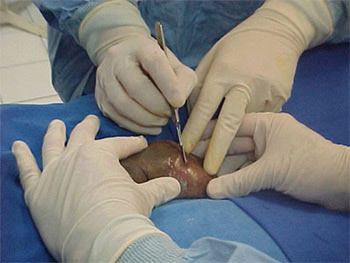
To help men with Azoospermia have a baby with their own sperm, testicular sperm is collected directly from the testes. This is called Testicular Sperm Extraction with ICSI (TESE-ICSI ).

This is a guest post by Dr. Sai, Senior Embryologist at Malpani Infertility Clinic

The collection of testicular sperm directly from the testes allows us to help men with azoospermia to have a baby with their own sperm ! This is called testicular sperm extraction with ICSI ( TESE-ICSI ). It's easy to find sperm in men with obstructive azospermia, because their testes produce sperm normally. However, it can be very challenging to find sperm in men with non-obstructive azoospermia who have partial testicular failure, because sperm production in these men is very patchy.

When doing a testicular biopsy, there is sometimes some bleeding, and often the testicular tissue which the surgeon hands over to the lab is blood stained. When these samples are processed in the lab to recover the testicular sperm, it's extremely difficult to identify viable sperms , because the RBCs obscure the field completely.

This is the protocol I use for processing testicular tissue for TESA at our centre .

  • Dissect the tubules with sterile tuberculin syringes. This allows me to separate the testicular tissue tubule wall from its content. I discard the content, and collect the content in a sterile 15cc centrifuge tube.
  • Centrifuge the content at 1200 rpm at 5 min.
  • Draw off the supernatant (discard)
  • Resuspend the pellet in 1 ml of room temperature RBC Lysis Buffer solution. This contains 8.3 g/L Ammonium Chloride in 0.01M Tris-HCL Buffer (pH of 7.5 + 0.2)
  • After 5 minutes, add 2 ml of room temperature sperm preparation medium.
  • Mix it gently and centrifuge at 1200 rpm for 5 min.
  • Draw off the supernatant.
  • Resuspend the pellet in 0.2 ml room temperature sperm preparation medium.

After processing , I place microdrops of the washed testicular tissue content on the ICSI dish , which is layered with culture oil. I then scan the sperm selection drop, and use the injection pipette to pick up the testicular sperm from the prep and move it to a PVP drop until injection.

There can be a lot of debris in the testicular homogenate ( precursor or immature sperm cells ) . Therefore it requires a lots of patience to process this tissue. I repeat this process until I have enough sperm to inject the eggs with, plus a few extra for spares.

Here's a case study of a very challenging patient we treated recently. He had non-obstructive azoospermia, with small testes ( volume of 6 ml); and a FSH level of 18.2 mIU/ml.

During the treatment cycle, our andrologist, Dr Vijay Kulkarni, took 6 microbiopsies from each testes on the day of egg collection. Because the tissue was blood stained, it was very difficult to identify the sperm. This is why the tissue suspension was treated with RBC Lysis Buffer as per the protocol mentioned above, to remove the RBCs.

This improved visibility dramatically, and it now became possible to identify a few testicular sperm. In the picture below, you can see the injection pipette picking up a single sperm. Note that the background is full of other testicular cells, which emphasizes the fact that finding testicular sperm requires a lot of expertise and patience ! Also note that there are very few RBCs ( the circular cells with a central halo) in this field.

It took me almost 2 hours to collect enough sperm. Since the RBCs had been cleared, identifying sperm was possible, making my task much easier ! However, the majority of sperms appeared abnormal. They had a cytoplasmic droplet, amorphous head or stumped tail, and none of them were motile.

3 hours later, 24 eggs were collected from the wife, of which 20 eggs were mature ( metaphase II) . All 20 eggs were injected, each with a single spermatozoon immobilized by stroking the tail.

After overnight culture, 11 oocytes showed two pronuclei and five 8-Cell and 6-Cell embryos (Grade B and Grade C) were transferred into the uterus on day 3.

The patient conceived in this cycle, and this pregnancy is presently progressing well.

Share     Print
   GET STARTED
Consult Dr.Malpani Online (Free)

Dr Malpani would be happy to provide a second opinion on your problem.

This is a free service!


Returning Patients - Login Here.
FERTILITY BOOSTERS EZINE:
Get the latest on all infertility related info.

Your Name:

Your Email Id:

ALSO READ 

Male Infertility : Preventing Male Infertility, Male Reproductive System
Read more...

The Man with a Low Sperm Count Oligospermia : Cause & Treatment
Read more...

Beyond Semen Analysis
Read more...

Low sperm count (Oligospermia)
Read more...

Male Infertility Treatment - and why it does not work
Read more...

ONLINE BOOK (GETTING PREGNANT)
A guide for the infertile couple.

Read now...


LATEST ARTICLES 

Why every IVF clinic needs a full time embryologist
Read more...

Why do so many women stop treatment after failing their first IVF cycle ?
Read more...

Science, IVF and God
Read more...

Making babies without making love
Read more...

Why do IVF patients drop out of treatment ?
Read more...

Atlas of ultrasound images during early pregnancy
Read more...

One more Malpani IVF Clinic success story !
Read more...

FROM THE BLOG 


MULTIMEDIA LIBRARY 
Comic Book - How To Have A Baby
View the Comic

Also in Hindi.
Comic Book - The Baby Chase
View the Comic
The World's First IVF E-Learning Course
View the Course
Patience Pays & Other Infertility Games
Play Games
RELATED WEBSITES 

Interactive Learning for IVF and more.
www.Ivfindia.com

All you wanted to know about IVF
www.Allaboutivf.com

Surrogacy in India - Finding / Being Surrogates
www.indiansurrogates.in

Egg Donation - Finding donors & treatment options
www.donoreggs.in

Embryo Adoption - Finding donors & treatment options
www.donorembryos.in

The Best Medical Care - How to get it from your doctors
www.the bestmedicalcare.com