
Autobiography of an Embryo in the IVF Lab
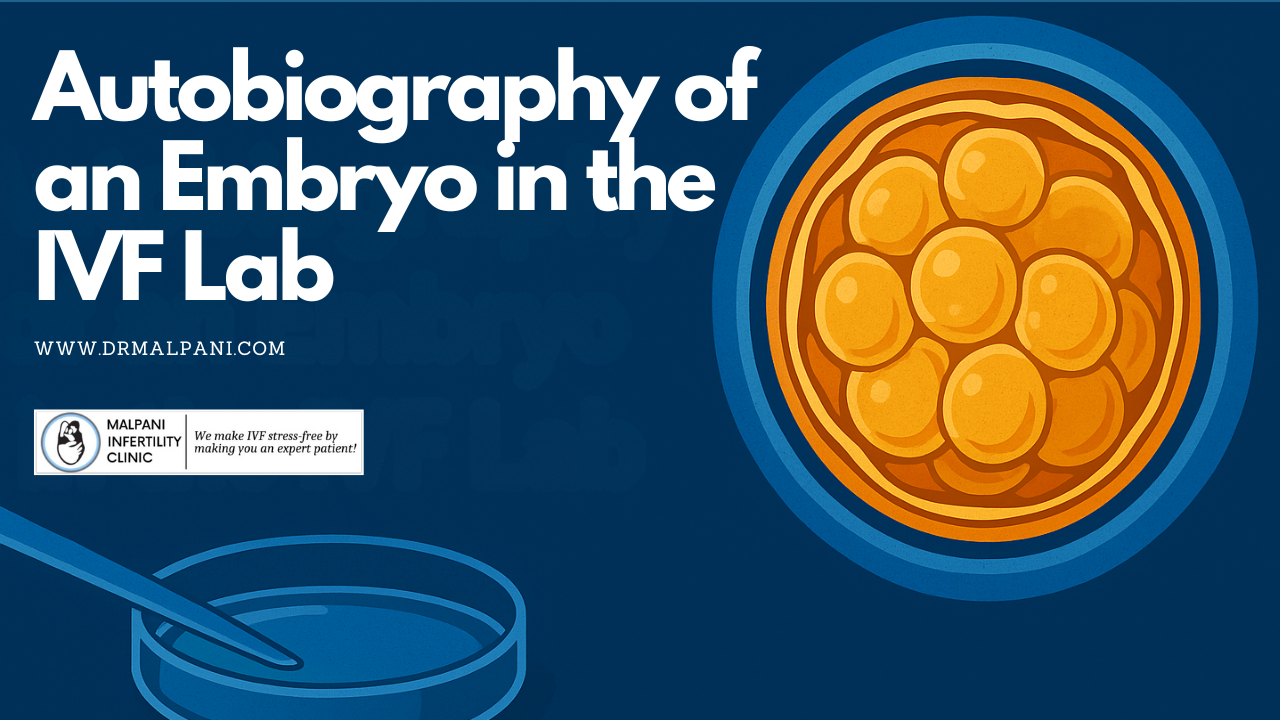
Patient: Dr Malpani, I’ve read a lot about IVF procedures, medications, scans… But what really happens after the eggs are retrieved? What happens to the embryos? How do they grow in the lab?
Dr. Malpani: That’s a wonderful question! Most patients only hear about embryo grading, day 3 vs. day 5 transfers, and success rates—but rarely do they understand the journey an embryo takes inside the IVF lab. Let me try something different today. How about I narrate the story from the embryo’s point of view?
Patient: That sounds fascinating—and very helpful! Please do.
Autobiography of an Embryo – My Journey in the IVF Lab
Embryo: Hello! I’m your potential baby. But for now, I’m just a zygote—a one-celled miracle created when your egg met his sperm in the IVF lab.
The journey started with egg retrieval, where Dr Malpani gently collected mature eggs from your ovaries. Your partner’s sperm was also collected and carefully prepared. The embryologist then combined the two using ICSI—injecting a single sperm directly into my mother’s egg. That’s how I was conceived!
I was placed in a tiny petri dish inside a special incubator, where the temperature, oxygen, and CO₂ were perfectly balanced—just like inside your body.
Day 1: The First Cell Division
Within 24 hours, I had to prove myself. Did I fertilise properly? The embryologist looked for two pronuclei—signs that both your egg and his sperm had done their part. Success! I was now a fertilised embryo.
Only those with normal fertilisation move forward. Others are discarded or monitored as abnormal. But I was healthy and strong—ready for my next challenge.
Day 2-3: Multiplying Cells and Embryo Grading
By Day 2, I had divided into 4 cells. By Day 3, I was at 8 cells.
Every day, the embryologists examined me under a microscope. They didn’t disturb me much, thanks to time-lapse incubators and careful handling. They graded me based on how evenly my cells divided, how clear my cytoplasm looked, and whether I had any fragments.
Dr Malpani believes in transparency, so he took photos of me and shared them with my parents. He explained my grade in plain English. No jargon. No hiding behind “lab secrets”.
Day 4-5: The Blastocyst Challenge
This was the real test. By Day 5, I had to transform into a blastocyst—a beautiful structure with a fluid-filled cavity, an inner cell mass (which becomes the baby), and a trophectoderm (which forms the placenta).
Many embryos don’t make it this far. But those who do have a higher chance of implanting in the uterus. I made it!
Dr Malpani and the team now had to decide whether to transfer me, freeze me, or let me grow a bit longer.
To Transfer or to Freeze?
Dr Malpani always puts science and the patient first, not numbers or revenue. He chooses elective single blastocyst transfers to avoid twins and ensure healthy pregnancies. If your uterus is ready, I might be transferred fresh. If not, I’ll be cryopreserved using vitrification.
Thanks to this advanced freezing method, I can be thawed later without any damage. In fact, frozen embryo transfers often have better pregnancy rates because they’re done in hormone-free, natural cycles.
My Siblings and I
Some of my brothers and sisters didn’t grow as well. Some stopped dividing. Some fragmented. And some just couldn’t become blastocysts.
But don’t be disheartened. That’s not a reflection of your body—it’s just nature’s way of selecting the best. Dr Malpani always says, “IVF is as much a diagnostic tool as a treatment.” It tells us how your eggs and his sperm behave together. And it guides us on what to do next.
Why Transparency Matters
Throughout this process, my parents were updated. No guesswork. No “Trust us blindly.” Every step, from fertilisation to blastocyst, was documented. Dr Malpani believes in empowering patients with knowledge.
And that’s what makes the IVF experience at Malpani Clinic stress-free and transparent. You’re not a passive participant. You’re an informed, respected partner.
Patient: This was such a moving way to explain the IVF lab process. I can now visualise what happens after egg retrieval. And I understand why some embryos don’t make it—without blaming myself.
Dr Malpani: Exactly. The IVF lab is like a highly controlled nursery. Not every seed becomes a plant, but the ones that do are strong and healthy. Our job is to nurture and select the best embryos—and to support you through each stage with honesty, empathy, and respect.
Key Takeaways for IVF Patients:
- Not all fertilised eggs become blastocysts. That’s normal.
- Embryo grading is a guide—not a guarantee of success.
- Blastocyst transfer improves implantation rates and reduces risks.
- Freezing embryos is a safe and effective option.
- Transparency matters ask for your embryo photos and lab notes.
- Stress-free IVF is possible when you’re treated with care and respect.