
What Happens During an Embryo Biopsy?
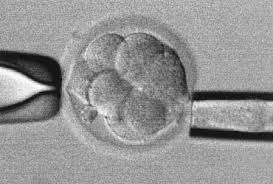
Maybe you have been told you need an embryo biopsy as part of your IVF cycle. Or perhaps you have read about preimplantation genetic diagnosis (PGD), and now you are anxious: What is really happening to your embryos in that lab? Will your precious embryos be safe? Will this help you have a healthy baby, or is it just another complicated step that makes the journey feel even scarier? If any of this sounds like what is going through your mind, you are not alone. Many couples feel a mix of hope and worry when they hear about embryo biopsy. Let’s break down exactly what happens, why it’s done, and how you can feel confident about your choices.
Why Do an Embryo Biopsy?
Embryo biopsy is not just another test. It is a highly advanced technique that offers couples a chance to understand their embryos better, before they are transferred into the uterus. For many, especially those who:
- Have experienced repeated IVF failures or miscarriages
- Have a known risk of passing on a genetic disease
- Are above 35 years old (as age increases the risk of chromosomal problems)
- Want to maximize their chances of a healthy pregnancy
...embryo biopsy can be a game changer. It is the first time science allows us to actually see if an embryo has the right number of chromosomes, or carries a specific genetic risk, before it is even implanted.
The Emotional Weight: Protecting Your Embryos
Let’s be honest: the idea of someone “taking a piece” out of your embryo can feel terrifying. You have worked so hard to get to this point, and the thought of anything going wrong is enough to keep you up at night. At Malpani Infertility Clinic, we understand this anxiety. We have seen hundreds of couples struggle with these fears. That is why we put a strong focus on safety and skill: embryo biopsy, when done by an experienced embryologist, is a delicate procedure that can be performed with minimal risk to your embryos.
It only takes one careless move for an embryo to be lost. This is why choosing a clinic with a skilled, detail-obsessed embryology team is non-negotiable.
Your embryos deserve precision. At Malpani Infertility Clinic, our team performs each biopsy under strict quality controls, using the most advanced micromanipulation equipment, to ensure your embryos remain unharmed and healthy for transfer.
Step by Step: What Actually Happens During an Embryo Biopsy?
Let’s walk through the process, using real images from our laboratory to help you visualize every stage. Understanding these details often helps reduce the fear of the unknown.
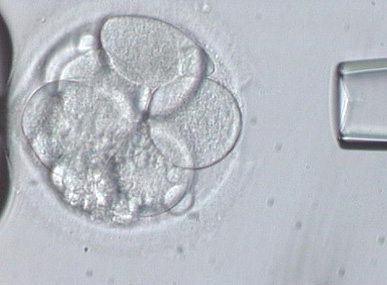 Fig 1. This is a 7-cell embryo, on Day 3 after IVF, ready to be biopsied. It is gently held in place with a holding pipette under a powerful microscope, using a device called a micromanipulator.
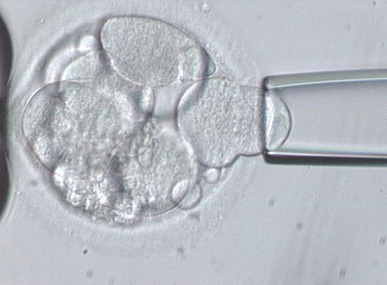 Fig 2. A precise laser creates a tiny hole in the outer shell of the embryo (called the zona pellucida). This makes it possible to access a single cell inside without harming the rest of the embryo.
 Fig 3. Through this opening, a very fine glass pipette is introduced. Gentle suction is applied to carefully pull out a single cell (called a blastomere) from the embryo.
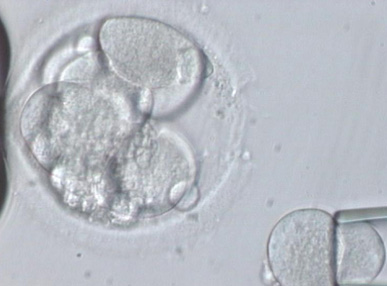 Fig 4. The blastomere is being removed. You can clearly see its nucleus, which contains all the DNA we need to analyze. This step is crucial: the cell must be taken intact, without damaging the rest of the embryo.
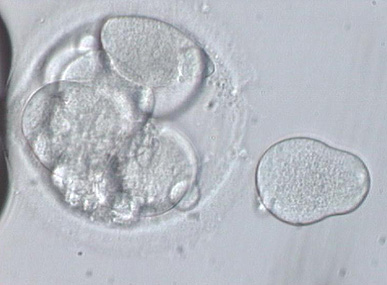 Fig 5. The biopsy is complete. The embryo, with one cell removed, is still completely intact. This process is repeated for each embryo that needs testing.
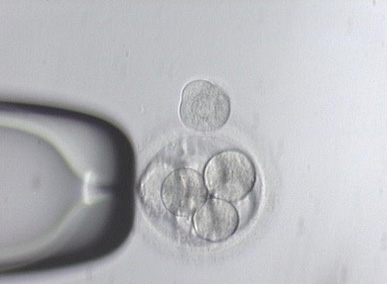 Fig 6. The biopsied embryo is checked to ensure it has not been harmed. It is then returned to the incubator to continue growing, just as it would if left alone.
 Fig 7. Now, the single cell (blastomere) that was removed is sent to our genetics lab for detailed analysis. Tests like FISH (Fluorescence In Situ Hybridization) can quickly check if the embryo has the right number of chromosomes, and whether it is male (XY) or female (XX).
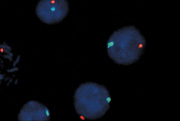 Fig 9. Here, you see the FISH signals from a normal male embryo. Each orange dot is an X chromosome, and each green dot is a Y chromosome. This kind of clear, visual result helps us decide which embryos are healthy for transfer.
Once the results are ready, usually within 4-6 hours, only the embryos with normal chromosomes are selected for transfer back into the mother's uterus. This maximizes your chance of a healthy pregnancy and reduces the risk of miscarriage or genetic disease.
Read more: Embryo Biopsy for PGD
What Happens After the Biopsy?
After the biopsy, your embryos are carefully watched as they continue to grow in the incubator. About 4-6 hours later, the genetic results are available. Only embryos that are found to be chromosomally normal are considered for transfer or freezing, depending on your personalized plan.
It is important to know that not every embryo will survive to this stage, and not every result will be “normal.” This can be hard to hear when you have invested so much emotionally and financially. But knowing the true health of your embryos helps you avoid heartbreak from failed implantation or repeated miscarriages later.
For more on PGD, visit Preimplantation Genetic Diagnosis The Newest ART
Is Embryo Biopsy Right for Everyone?
Not every couple needs embryo biopsy. For some, especially younger women with no known genetic risk and a small number of embryos, the benefits may be less significant. But for those with a history of failed IVF, recurrent pregnancy loss, family history of genetic diseases, or older maternal age, it can be a game changer.
In women above 38, more than half of embryos may carry chromosomal abnormalities. Embryo biopsy helps identify the healthy ones.
Every situation is unique. At Malpani Infertility Clinic, Dr. Malpani will always tell you the honest truth about whether this procedure is worth it for your specific case. We believe in empowering you with facts, not false promises.
What to Ask Your IVF Clinic Before Saying Yes
Before agreeing to embryo biopsy, consider these questions:
- How many embryo biopsies has your embryologist performed?
- What success rates does your clinic have for PGD/PGS cycles?
- Which labs will analyze the cells, and how quickly are results given?
- How are embryos handled and protected during and after the procedure?
Your embryos are your future. You deserve transparency and care at every step. Do not hesitate to ask tough questions—at Malpani Infertility Clinic, we welcome them. We want you to feel safe and empowered, not overwhelmed or rushed into decisions.
Frequently Asked Questions
Q: Will embryo biopsy harm my embryos or reduce my chances of pregnancy?
A: When performed by highly skilled embryologists, embryo biopsy is safe for most embryos. The procedure is very delicate, but with modern techniques and expert hands, the majority of embryos survive and continue developing normally.
Q: How do I know if I actually need embryo biopsy?
A: Embryo biopsy is most helpful for couples with a history of failed IVF, repeated miscarriages, known genetic risks, or older maternal age. If you are younger and have no family history of genetic disease, your doctor will discuss whether the benefits outweigh the risks in your case.
Q: How soon are the genetic results available after a biopsy?
A: At Malpani Infertility Clinic, results are typically available within 4-6 hours, thanks to advanced laboratory techniques.
Q: What happens to embryos that are found to be abnormal?
A: Embryos with chromosomal or genetic abnormalities are not used for transfer. Only normal embryos are selected, to maximize your chance of a healthy pregnancy and baby.
Q: Can I choose the gender of my baby using embryo biopsy?
A: Embryo biopsy and PGD can determine embryo gender, but this is only offered for medical reasons (such as avoiding gender-linked diseases) and not for non-medical selection, in line with Indian regulations.
Q: How do I find a clinic I can trust to do this safely?
A: Look for clinics with experienced embryologists, high success rates, and transparent communication. At Malpani Infertility Clinic, we invite you to ask as many questions as needed to feel confident in your care.