

Why PGS testing is unreliable
Maybe you are reading this because your doctor or IVF clinic suggested preimplantation genetic testing for aneuploidy (PGT-A, previously called PGS) as a way to increase your chances of pregnancy. Maybe you have been told that this test can spot and filter out “bad” embryos, giving you the best shot at a healthy baby. If you are feeling confused, pressured, or even hopeful that PGT-A is your missing piece, you are not alone. Many patients arrive at Malpani Infertility Clinic with these exact questions and uncertainties.
What Is PGT-A and Why Do Clinics Recommend It?
PGT-A is a form of genetic screening performed on embryos created during IVF. The goal: to identify embryos with the correct number of chromosomes (euploid) and to avoid transferring embryos with too many or too few chromosomes (aneuploid), which could fail to implant or lead to miscarriage. On the surface, this sounds logical and reassuring. Who would not want to increase the odds of success and reduce heartbreak?
It is no surprise, then, that many IVF clinics strongly suggest PGT-A, sometimes making patients feel it is almost mandatory. The pitch is simple: “We will only transfer the very best embryos, so you have a higher chance to get pregnant.” But is this promise really backed by solid science? Or is it a story that sounds comforting, especially when you are desperate for hope?
The Science: Does PGT-A Actually Help Most IVF Patients?
Let us look closely at what the evidence says. Recent, large, high-quality studies have shown that for women under 38 who have a reasonable number of embryos, adding PGT-A does not improve the chance of taking home a healthy baby. In fact, in some cases, it can lower your chances because some embryos labeled “abnormal” by PGT-A still have the potential to result in healthy pregnancies and babies. The test is not as perfect as it sounds.
To break it down:
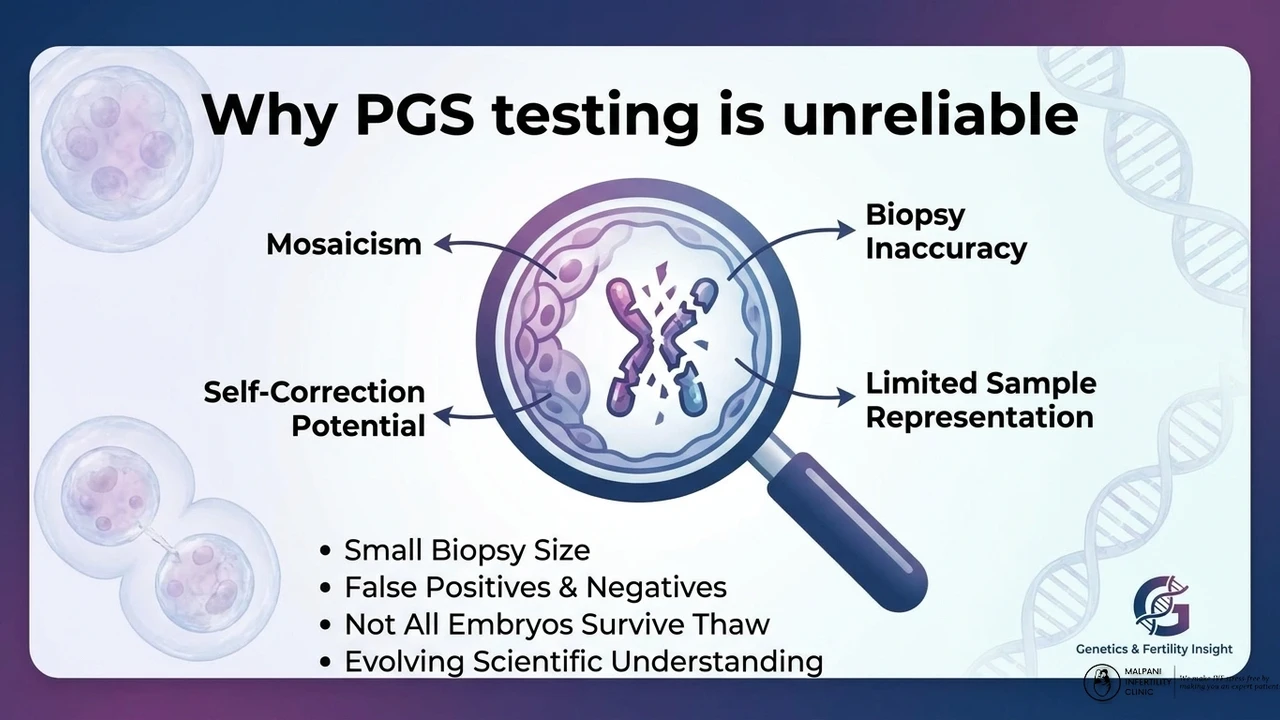
- PGT-A looks at a few cells from the embryo’s outer layer, not the whole embryo.
- Sometimes, the cells tested are not representative—meaning the embryo might actually be healthy even if a few cells look abnormal.
- Embryos can be “mosaic”—a mix of normal and abnormal cells—and many mosaic embryos can self-correct and become healthy babies.
- Lab errors and technical limitations mean that some embryos are falsely labeled as abnormal and discarded, even though they might have worked.
In one large randomized trial, women who used PGT-A actually had a slightly lower live birth rate than those who did not use PGT-A. This is not just a tiny detail. It means that relying on PGT-A could mean losing out on your best chance at pregnancy.
Women in the conventional IVF group had a live birth, compared to 77% in the PGT-A group in a major study.
Why Do So Many Clinics Push PGT-A?
If the science is so shaky, why is PGT-A still so popular? The answer is complicated, but it boils down to hope, pressure, and sometimes business interests. Clinics want to offer the “latest” and “most advanced” options. Patients, understandably, want to do everything possible for success. Sometimes, the test is offered as a “safety net” or an “upgrade”—but at a significant cost, both financially and emotionally.
There is also confusion in how results are presented. Some clinics focus on “success per embryo transfer,” ignoring all the embryos that were thrown away. But what matters most to you is not just a good-looking number—it is whether you take home a baby at the end of your IVF journey.
Many healthy babies have been born from embryos that PGT-A had labeled as abnormal or mosaic.
At Malpani Infertility Clinic, we believe in giving patients the unfiltered truth. Our first priority is your chance of success, not just offering every available test. We want you to understand the risks, benefits, and limitations of every step—so you can make the best decision for your family.
What Are the Real Risks of PGT-A?
The biggest risk is that you might throw away embryos that could have resulted in a healthy baby. This is because:
- The technology is not perfect. Embryos are complex, and a small sample may not tell the whole story.
- Embryos labeled as “abnormal” or “mosaic” are often still capable of resulting in a healthy pregnancy.
- PGT-A can give false positives (labeling a good embryo as abnormal) and false negatives (missing a real abnormality).
For some couples, especially those with very few embryos, this risk is enormous. Each embryo is precious. Discarding even one potentially healthy embryo can mean losing your best or only chance at pregnancy.
Are There Any Patients Who Might Benefit from PGT-A?
There is still debate among fertility experts. Some suggest that in certain situations—such as women with repeated failed IVF cycles, recurrent miscarriages, or older age—PGT-A could have value. But even in these groups, the evidence is far from clear. No one-size-fits-all answer exists. That’s why at Malpani Infertility Clinic, we take a personalized approach. We look at your age, your previous IVF results, your embryo quality, and your personal history before recommending any add-on test.
We also believe patients deserve honest information. Some doctors will not tell you that the test is far from perfect. We will. We will help you understand whether PGT-A is truly likely to help or harm in your unique case.
Making the Choice: What Should You Do?
It is completely normal to feel overwhelmed or pressured when you are struggling with infertility. You might feel like you have to try every add-on or test, just in case. But more is not always better. Sometimes, the best thing you can do for yourself is to step back, ask tough questions, and make choices based on evidence—not on fear or sales pitches.
If you are uncertain, confused, or anxious about whether to do PGT-A, you can always talk to an expert fertility advisor at Malpani Infertility Clinic. We are here to listen to your individual story, review your medical details, and help you decide what gives you the best shot at the family you dream of—without unnecessary tests, costs, or risks.
For more in-depth reading and evidence, you can check these resources:
- NEJM: PGS testing and its limitations
- Why PGS testing can be inaccurate
- Embryos that could have become healthy babies
- More information on PGT-A add-ons (HFEA)
- Problems with PGT-A: Opinion
- PGT-A: what's it for, what's wrong?
Frequently Asked Questions
Q: What exactly is PGT-A (or PGS)?
A: PGT-A stands for preimplantation genetic testing for aneuploidy. It is a test performed on embryos created in IVF to check for chromosomal abnormalities before transferring them into the uterus.
Q: Does PGT-A guarantee a higher chance of pregnancy?
A: No. Large studies show that for most women, especially those under 38, PGT-A does not increase and may even decrease the chance of having a baby.
Q: Can PGT-A ever be useful?
A: In some specific cases—such as repeated IVF failures or certain genetic risks—PGT-A may have some value. However, the evidence is still unclear, and it should not be used routinely for everyone.
Q: What is the risk of discarding healthy embryos?
A: The main risk is that embryos labeled as abnormal or mosaic by PGT-A may still result in healthy pregnancies. Discarding them means losing potential chances at a baby.
Q: Why do so many clinics recommend PGT-A if it is not proven?
A: Some clinics may offer it out of hope, as an add-on, or due to patient demand. Sometimes, it is also a business decision. Patients need to be cautious and ask for evidence.
Q: How can I make the best decision for my situation?
A: The best approach is to discuss your personal case with an experienced fertility expert who will give you honest, evidence-based advice, not just sell you add-ons.
Q: Where can I get more unbiased information about PGT-A?
A: You can read patient information from trusted sources like the HFEA, and speak to clinics like Malpani Infertility Clinic who prioritize transparent guidance over sales pitches.