
Test Tube Baby : In Vitro Fertilization , IVF, ICSI

You’re probably here because you are tired, tired of waiting, tired of hoping, tired of hearing “just relax and it will happen.” Maybe you have been told your tubes are blocked, your sperm count is low, or that no one can explain why you haven’t conceived. Maybe you’ve tried everything you could, and every “next step” feels overwhelming. But you’re not alone, and you deserve honest answers and real choices. If you’re searching for what IVF, ICSI, and test tube baby treatments truly mean for people like you, this is for you.
What Are Assisted Reproductive Technologies?
Assisted reproductive technologies (ART) like IVF (in vitro fertilization) and ICSI (intracytoplasmic sperm injection) are not just scientific breakthroughs, they are lifelines for couples who want a child but face obstacles nature put in the way. When Louise Brown, the world’s first “test tube baby,” was born in 1978 (watch the fertilization video), hope became reality for millions. Today, these treatments are no longer last resorts. They are proactive options, offering hope to couples who thought their chances were gone.
Fig 1. World's first test tube baby
ART is about giving you a real shot at parenthood when traditional methods have not worked. Whether there’s a known cause, like blocked tubes, severe sperm problems, or endometriosis, or things are just unexplained, these technologies let doctors help where Mother Nature stalls. The science may sound advanced, but the purpose is simple: to help you build the family you dream of.
The Basics of IVF and ICSI
IVF is a process where eggs and sperm are joined outside the body in a laboratory dish. The embryos that form are then placed back into the uterus, where they can continue to develop naturally. ICSI is a specialized form of IVF where a single sperm is directly injected into an egg, helping when sperm can’t naturally reach or penetrate the egg.
- IVF is often used for blocked tubes, unexplained infertility, endometriosis, or mild male issues.
- ICSI is especially helpful when sperm counts, movement, or shape are not ideal, or when previous IVF cycles showed poor fertilization.
Both treatments follow a series of steps, but the goal is always the same: to overcome the hurdles standing between you and a healthy pregnancy.
What Tests Happen Before IVF or ICSI?
There’s a lot of anxiety around medical tests, but understanding them helps you take control. At Malpani Infertility Clinic, we focus on three essentials: eggs, sperm, and uterus. These are the core of any successful IVF.
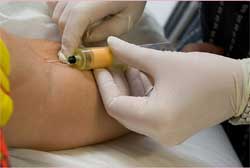 Fig 2. Blood being drawn for testing
- Sperm Survival Test: This simple test checks if enough healthy sperm can be recovered. It mimics the real sperm washing method used in IVF, helping the lab team decide on the best approach for your sample.
- Ovarian Reserve Assessment: A blood test for FSH (follicle stimulating hormone) tells us how many eggs your ovaries might produce. If you’re older, a clomiphene challenge test may be done. If results suggest low ovarian reserve, using donor eggs might be discussed honestly with you.
- Uterine Evaluation: Some clinics do a hysteroscopy to make sure the womb is healthy and ready. A mock embryo transfer may be performed to check for any technical problems. Infections are checked with cervical swabs.
- Special Cases: If tubes are blocked and filled with fluid (hydrosalpinges), removing them before IVF can improve results. Men who find it hard to produce a semen sample on the day can freeze a sample earlier as a backup, no shame, just practical planning.
- Bloodwork: Tests for rubella immunity, Hepatitis B, and HIV/AIDS are standard. We recommend starting folic acid before treatment to lower the risk of certain birth defects.
These steps are not about adding hurdles. They’re about making sure when you begin treatment, you have the best possible chance, and no one is left guessing.
Most couples only need eggs, sperm, and a receptive uterus to try IVF, everything else is about increasing your odds and keeping you safe.
There are some situations where chances are lower:
- Older women with very few eggs left. Age matters, but it’s the egg quality that is crucial. There is no strict upper age limit, but expectations must be realistic.
- Men with extremely low sperm counts. If fewer than 3 million motile sperm are available, ICSI is usually the better route.
- Women with a damaged uterus, such as from old infections like tuberculosis, may have lower chances of embryo implantation.
- It’s best not to rush into IVF without trying simpler options first unless your situation truly calls for it. IVF is an investment, emotionally, physically, and financially.
The Five Steps of an IVF Cycle
Knowing what to expect can calm the nerves and help you feel in control. IVF is not a mysterious black box, it’s a series of clear, careful steps:
- Superovulation: Medications help your ovaries produce several eggs instead of just one.
- Egg Retrieval: Eggs are collected gently from the ovaries, usually under light sedation.
- Fertilization: Eggs and sperm are mixed together (or a single sperm is injected in ICSI).
- Embryo Culture: The embryos grow in a safe, controlled environment for a few days.
- Embryo Transfer: The best embryo(s) are carefully transferred into your uterus.
Each step is guided by monitoring and adjustments tailored to your body’s response. We believe in letting you understand what’s happening at each stage, so nothing ever feels out of your hands.
Superovulation: How It Works and Why It’s Needed
Superovulation is one of the most misunderstood yet vital parts of IVF. Instead of hoping one egg will do the trick, we aim for several to boost your chances. This is done with daily hormone injections for 9 to 12 days. You may hear about medicines like HMG, FSH, HCG, and GnRH analogs, but what matters is that the protocol fits you, not some generic template.
Most clinics, including ours, use GnRH analogs (such as leuprolide or buserelin) alongside gonadotropins. These analogs prevent your body from ovulating too soon, giving doctors more control and you more predictability. There are two main ways to use them:
- Long protocol: GnRH analogs started from day 21 of the cycle.
- Short protocol: Started from day 1, especially for some special cases.
Newer medications called GnRH antagonists (like Antagon or Cetrotide) may also be used for better timing, though pregnancy rates are similar.
 Fig 3. GnRH antagonist used for downregulation
Monitoring and Adjusting Your Cycle
You might worry about all the scans and blood tests, but at Malpani Infertility Clinic we believe kindness matters. We use ultrasound scans, especially starting around Day 3 of your cycle, to make sure there are no ovarian cysts and your ovaries are in the right state to begin. Blood tests for estradiol can help, but they’re only used when absolutely necessary to avoid unnecessary pokes.
 Fig 4. Ultrasound scan of an ovary during superovulation. There are more than 6 follicles in this image. All the follicles are growing well. It is likely the doctor will be able to retrieve one egg from each of these follicles during egg retrieval
We personalize your medication dose based on what we see:
- 225 IU daily for women under 35
- 300 IU for women over 35
- Higher doses for “poor responders”
- Lower doses for women with PCOD
Key milestones are tracked using ultrasound, your follicles should be growing 1-2 mm per day. When the largest follicles reach around 18 mm and your uterine lining looks thick and healthy (over 7 mm, with a triple pattern), we plan egg retrieval. At this point, a final injection (HCG) triggers ovulation so we can collect the eggs at the perfect time.

Fig 5. Ultrasound scan of the uterus during an IVF cycle. The central endometrial stripe is thick and trilaminar, suggesting that the uterus has responded well and is ready for embryo implantation

Fig 6. Ultrasound scan of an ovary during superovulation. This shows how we measure each follicle. A mature follicle is about 18 mm in size.
Here’s what a typical schedule might look like:
- Day 1-3: Start GnRH analogs, check for cysts on ultrasound
- Day 4-10: Add HMG injections, regular scans every 2 days
- Day 14-16: When follicles are mature, give HCG injection and plan egg retrieval 36 hours later
We continue daily medications and scans every alternate day until your follicles are ready. The schedule is always adjusted to your body’s actual response.
There’s no “one size fits all” in IVF. Your protocol is as unique as you are, and you deserve to know why every decision is made.
When an IVF Cycle Needs to Be Cancelled
This is a topic many clinics avoid, but you need the truth. Sometimes, despite everyone’s best efforts, a cycle has to be stopped. The most common reason is a poor response: if fewer than three follicles grow or hormone levels are too low, continuing may not be worth the disappointment. This happens more often in older women or those with high FSH.
It’s heartbreaking when cycles get cancelled, especially for young women who expect lots of eggs. But this isn’t the end. Often, tweaking the protocol or increasing medication can improve your chances in the next try.
On the other hand, some women with PCOD may respond too strongly and grow too many follicles. If there are more than 25 follicles or estradiol levels soar, the risk of ovarian hyperstimulation syndrome (OHSS) is high. Instead of cancelling, we may collect the eggs, fertilize them, and freeze all embryos for transfer in a later, safer cycle.
At Malpani Infertility Clinic, we use a special egg collection technique with a double-lumen needle, allowing us to flush out the cells that cause OHSS. This reduces your risk significantly, so we rarely have to cancel cycles for overstimulation.
of IVF cycles at our clinic are completed safely without cancellation, thanks to individualized protocols and advanced techniques.
The Path Forward: Real Hope, Real Answers
IVF and ICSI are not just acronyms, they are journeys filled with hope, anxiety, decisions, and sometimes setbacks. The science is advanced, but your experience should always feel human, respectful, and empowering. At Malpani Infertility Clinic, we believe in full transparency: you will always know what’s happening, why, and what your true chances are, not just what we think you want to hear.
If you’re unsure what path is right for you, or if you want a second opinion or a breakdown of your options, you can always talk to an expert fertility advisor for guidance that is honest, specific, and tailored to your needs.
Frequently Asked Questions
Q: What exactly is the difference between IVF and ICSI?
A: IVF mixes eggs and sperm in a lab dish, letting fertilization happen naturally. ICSI is used when sperm cannot penetrate the egg on their own, one sperm is directly injected into each egg.
Q: Are there risks to babies born from IVF or ICSI?
A: The risk of birth defects is slightly higher compared to natural conception, but still very low. Most babies born from IVF or ICSI are healthy. Some of the increased risk may be linked to underlying fertility issues, not the procedure itself.
Q: How many eggs are needed for a successful IVF cycle?
A: Success can happen with just a few eggs, but having more eggs increases the chances of creating healthy embryos. The exact number depends on your age and ovarian reserve.
Q: Can IVF or ICSI help if my partner has very low sperm count?
A: Yes. ICSI is designed specifically for severe male factor infertility, including very low sperm counts or poor sperm movement.
Q: What happens if my cycle is cancelled?
A: A cancelled cycle is disappointing, but it allows your doctor to review your response and adjust medications for better results next time. It does not mean you cannot succeed with IVF in the future.
Q: Is there an age limit for IVF?
A: There is no strict age limit, but chances of success depend on egg quality, which declines with age. Women in their 40s may have lower success rates and may be advised to consider donor eggs.
Q: How do I know which protocol is right for me?
A: The best protocol is chosen based on your medical history, age, ovarian reserve, and previous responses to stimulation. Your doctor should explain why a particular plan is recommended for you.