

What Do Day 2 and Day 3 Embryos Look Like?

It is one of the strangest feelings: you have gone through the physical and emotional rollercoaster of IVF, and now you are waiting, wondering what is happening in the lab. Are your embryos dividing as they should? Are they "good"? What does that even look like? If you find yourself asking these questions and imagining tiny cells under a microscope, you are not alone. Every patient at Malpani Infertility Clinic has sat where you are now, hoping for some clarity and reassurance during these uncertain days.
What Happens to Embryos in the Early Days After IVF?
After egg retrieval and fertilization in the IVF lab, your embryos begin their journey of growth and division. At Malpani Infertility Clinic, we believe in being completely transparent with our patients. We want you to understand how your embryos develop, what the scientists are looking for, and how these observations guide the next steps in your treatment. You can see what embryos look like on Day 1 at this link.
Day 2 Embryos: The First Signs of Life
On Day 2 after fertilization, your embryos are starting their first cell divisions. Most embryos at this stage have between 2 to 4 cells. This is called the "cleavage" stage, where the single fertilized egg splits into separate but connected cells. If you are visualizing your embryos, imagine them as small clusters—each cell like a room in a tiny apartment, working hard to grow.
- Day 2 embryos generally have 2 to 4 cells.
- Embryos with 4 cells of equal size and no fragments are considered top quality (Grade A).
But what does “quality” mean? Embryologists grade Day 2 embryos based on two main factors:
- Cell Size: Are the cells equal in size, or are some larger than others?
- Fragmentation: Are there small bits (fragments) that are not part of the main cells? How much of the embryo is made up of these fragments?
Here is what different grades look like:
Even a lower-grade embryo can sometimes become a healthy baby. The grading system helps us choose, but it does not guarantee outcomes.
What Do Day 2 Embryos Actually Look Like?
Grade A Embryo (4-Cell)
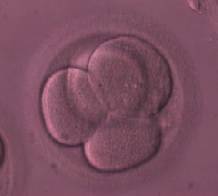
- This is a top quality Day 2 embryo.
- The four cells are equal in size.
- There is no fragmentation—meaning the cells are clear and compact.
Grade A Embryo (2-Cell)

Grade B Embryo (4-Cell)

- Cells are equal in size.
- There is more than 15% fragmentation—small fragments can be seen between the cells.
Grade C Embryo (4-Cell)

- The cells are not equal in size—some are bigger, some smaller.
- Fragmentation is more than 50%—there are many bits and fragments around the cells.
Day 3 Embryos: The Cleavage Continues
On Day 3, embryos have usually divided further. At this point, the best embryos have 6 to 8 cells. The grading principles remain the same: size and symmetry of cells, and the amount of fragmentation. Embryologists also start looking for signs that the embryo is ready to take the next developmental step.
- Day 3 embryos generally have 6 to 8 cells.
- Embryos with 8 cells of equal size and no fragments are considered top quality (Grade A).
How Are Day 3 Embryos Graded?
- Cell Size: Are all the cells about the same?
- Fragmentation: Is there very little, moderate, or a lot?
Grade A Embryo (8-Cell)

- This is a top quality Day 3 embryo.
- All eight cells are equal in size.
- There is no fragmentation—just clean, round cells.

Grade A Embryo (6-Cell)
Sometimes, a 6-cell embryo can also be considered high quality if the cells are equal in size and there is no fragmentation.
Grade B Embryo (8-Cell)

This embryo has eight cells, but the cells are not all the same size. There is no fragmentation, but the uneven sizes make it a Grade B.

This 8-cell embryo has equal sized cells, but there is more than 15% fragmentation, so it is graded as B.
Grade C Embryo (8-Cell)

This embryo shows both unequal cell sizes and over 50% fragmentation—visible as lots of little bits around the cells.
Fast-Growing and Compacting Embryos: What If My Embryo Is Growing Faster?
Sometimes, embryos grow a bit faster than others. On Day 3, you may see embryos that are already starting to compact (cells fuse together) or even have more than 8 cells, such as a 12-cell embryo. These signs can be positive, showing that the embryo is energetic and developing well.


- 8-cell Grade A compacting embryo
- 12-cell Grade A embryo
At Malpani Infertility Clinic, our embryologists carefully watch for these signs of healthy development when choosing which embryos may be best for transfer.
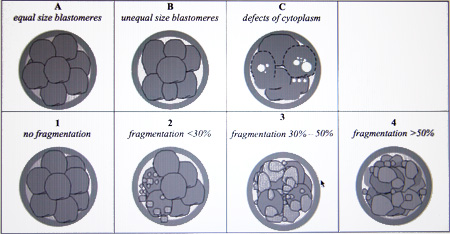
This figure is a schematic showing how we grade embryos in the lab. The goal is to select the embryos with the best potential, but we always remind our patients that even embryos that look less perfect can surprise us and result in healthy pregnancies.
What Happens Next? From Cleavage Stage to Blastocyst
After Day 3, embryos continue to divide and start to compact into a ball of cells called a morula, and then form into a blastocyst by Day 5. The best blastocysts are usually transferred back into the uterus. You can see what blastocysts look like at this link.
Not every embryo will reach the blastocyst stage, and not every blastocyst will implant. The journey from a single cell to a baby is full of twists and turns. Our team at Malpani Infertility Clinic is here to guide you with honest advice, advanced lab techniques, and all the emotional support you need—because we know how hard it is to wait and worry.
It is natural to feel anxious about how your embryos are doing, but remember: your value and your chances are not defined by one number or one photo from the lab.
Frequently Asked Questions
Q: What does a "good quality" embryo mean?
A: Good quality embryos, usually called Grade A, have cells of equal size and little or no fragmentation. These embryos are more likely to reach the blastocyst stage and be selected for transfer, but even lower grades can still result in a pregnancy.
Q: My embryo was not perfect. Does that mean I cannot get pregnant?
A: Not at all. Many pregnancies come from embryos that did not look perfect in the lab. Embryo grading is a guide, not a guarantee.
Q: What is fragmentation in embryos?
A: Fragmentation means there are small bits of cell material not part of the main cells. A small amount is common and usually not a problem, but heavy fragmentation might affect the embryo's potential.
Q: How do you decide which embryo to transfer?
A: Our embryologists look at cell number, size, fragmentation, and growth speed. The embryos that tick the most boxes are usually chosen, but your overall situation and history are always considered.
Q: What are my options if I do not have a Grade A embryo?
A: We may still recommend transferring or freezing Grade B or even Grade C embryos, depending on your case. Sometimes, these embryos can surprise everyone.
Q: Where can I see what blastocysts look like?
A: You can view images and learn more about blastocysts at this link.
Q: How can I get more personalized advice about my embryos?
A: You can always book a consult or chat with Dr. Malpani for tailored guidance and honest answers about your situation.