

Can Fallopian Tube Recanalization Help You?
Maybe you have found yourself staring at your HSG report, heart thumping, reading the words: “cornual block” or “proximal tubal occlusion”. Maybe you have already been trying for a baby for months, or even years, and now you are being told your fallopian tubes are blocked. Suddenly, words like “recanalization” sound technical and distant, but what you really want to know is: Is there hope? Could this be the missing piece? Will you ever get to see those two pink lines?
Understanding Fallopian Tube Blockage: Not All Blocks Are the Same
Let’s be honest: hearing that your tubes are blocked can feel devastating. You might be wondering if this means IVF is your only option, or if you have lost your chance at a natural pregnancy. The truth is, not all tube blocks are equal, and some can be fixed with the right medical approach. The key is understanding exactly where and why the blockage is happening.
The fallopian tubes are delicate passageways that connect your ovaries to your uterus. Eggs travel through them, and so must the sperm, for fertilization to happen. Sometimes, the tubes get blocked at the very beginning, right where they meet the uterus. This is called a “cornual” or “proximal” block.
Diagnosing a cornual block usually starts with an HSG (hysterosalpingogram) — an X-ray that shows the shape of your uterus and tubes. Sometimes, a hysteroscopy or laparoscopy is done for clearer answers.
What is Fallopian Tube Recanalization?
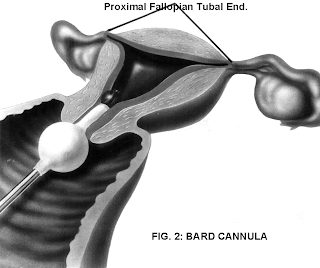
Fallopian Tube Recanalization (FTR) is a gentle, non-surgical procedure that aims to open up tubes that are blocked at the cornual end. Think of it as clearing a clog from a pipe, but in the safest, most precise way possible. It is done using advanced X-ray technology, so the doctor can see exactly where the block is and work with delicate instruments to clear it.
- A thin, flexible wire or balloon is carefully threaded through the cervix and uterus to the site of the blockage.
- If the blockage is due to a mucus plug or debris, the wire gently pushes it out, reopening the tube.
- The entire process is guided in real time by imaging, so there’s no guesswork.
Some women are candidates for recanalization using hysteroscopy, where a tiny camera is used to directly see and clear the blockage from inside the uterus.
Many women with a cornual block who try recanalization go on to conceive naturally, avoiding the need for IVF.
Will Recanalization Work for Me?
This is the question every patient wants answered. And it is absolutely fair to want clarity.
The hard truth: recanalization is not a miracle cure for all types of tube blockage. The best candidates are women whose block is at the uterine end and is caused by soft, removable material — not by scarring or permanent damage. If your tubes are blocked in the middle or at the far (distal) end, or if you have hydrosalpinx (a swollen, fluid-filled tube), FTR is unlikely to help.
- If you have had tuberculosis affecting your tubes, or severe pelvic infections, recanalization will not work, because the damage is deeper and more permanent.
- Your doctor can help distinguish between a temporary plug and a true, irreversible block.
At Malpani Infertility Clinic, we believe in honest conversations. We will never promise you miracles, but we will make sure you understand your own body and your options.
success rate for reopening blocked tubes with recanalization, if women are properly selected.
What is the Procedure Like?
Many women worry about pain, safety, and what exactly happens during recanalization. The procedure is usually done on an outpatient basis, and no incisions are made. Here is what you can expect:
- You lie comfortably on an X-ray table. A small tube (catheter) is passed through your cervix into your uterus — much like an HSG.
- A special dye is injected to visualize the blockage.
- If a block is found, a fine wire or balloon is threaded through the tube to gently clear the obstacle.
- The entire process is watched on a screen, so the doctor can be precise and gentle.
- Most women feel only mild discomfort, similar to menstrual cramps, and can go home the same day.
Afterwards, you will be monitored for a short while. Most women can return to their normal activities the next day.
What Happens After Recanalization?
It is normal to feel a mix of hope and anxiety while waiting. Here is what we have learned from guiding hundreds of couples:
- If the tube is reopened and was blocked by soft debris, you have a real chance of conceiving naturally in the following months.
- The first six months after the procedure are when most pregnancies occur, if the procedure has worked.
- Sometimes, unfortunately, tubes can get blocked again. If you do not conceive within six months, it is time to consider other options, such as IVF.
We know how hard it is to keep your spirits up through the ups and downs. At Malpani Infertility Clinic, we walk with you through every step, ensuring you have both the emotional and medical support you need to make decisions that are right for you.
No False Promises, Just Clear Guidance
There are many myths and half-truths about treating tubal blocks. The reality is:
- Recanalization works best for the right kind of block, at the right location, and in the right hands.
- It is not suitable for every tubal block — especially not for those caused by infections like tuberculosis, or for women with severe tubal damage.
- If recanalization fails, there is still hope: IVF is an excellent next step for many women.
We believe you deserve real answers, not empty reassurances. That is why we take time to explain every detail, and to tailor your plan to your unique situation. If you feel overwhelmed or confused, you are not alone. The best way forward is to sit with an expert, talk through your reports, and understand what is actually happening in your case.
Frequently Asked Questions
Q: What is the difference between a cornual block and other types of tube blocks?
A: A cornual block is at the very beginning of the fallopian tube, where it meets the uterus. Other blocks can happen in the middle or far end of the tube. Cornual blocks are often caused by soft plugs, which can sometimes be removed.
Q: How do I know if I am a candidate for recanalization?
A: If your HSG or other tests show a block at the uterine end of your tube and there is no history of severe infection or tuberculosis, you may be a candidate. An expert doctor can review your reports and advise you honestly.
Q: What are the risks of fallopian tube recanalization?
A: The risks are low. Mild cramping or spotting may occur. Rarely, infection or perforation can happen, but this is extremely uncommon in experienced hands.
Q: How soon after FTR can I try for pregnancy?
A: You can usually start trying to conceive as soon as you feel ready, often from your next cycle. Most pregnancies occur in the first six months after the procedure.
Q: What if my tubes get blocked again?
A: If pregnancy does not happen within six months after a successful FTR, it is wise to consider IVF as the next step. Sometimes tubes can re-block, and waiting too long may waste precious time.
Q: Does recanalization guarantee pregnancy?
A: No. While it can restore the pathway for egg and sperm to meet, other factors like egg quality, sperm health, and uterine environment also play a role. Recanalization gives you a chance, but not a guarantee.