
Everything you need to know about Freezing and Thawing of Embryos.
Saiprasad Gundeti, Chief Embryologist, Malpani Infertility Clinic Pvt. Ltd.
Embryo Freezing (Vitrification)
In IVF treatment, Spare embryos are frozen for Future Cycles after transferring the best embryos.
The embryos are Frozen using a slow Freezing technique or Vitrification technique.
The slow freezing technique is outdated and not used anymore.
In slow freezing the Embryos were frozen by exposure to a low concentration of cryoprotectants and a gradual decrease in temperature in a controlled manner using a cooling device.
The major disadvantage of Slow freezing is Ice crystal formation in the Embryos.
With the slow freezing technique, survival rates were suboptimal, since ice crystals formed in the embryos caused potential damage to the embryo during the thawing process.
Vitrification is an ultra-rapid cooling technique. This technique involves Exposing the embryos to the high concentration of cryoprotectant to dehydrate the Embryos, where water molecules in the Embryo are replaced by cryoprotectant.

Since Embryo is cooled ultra rapidly, there is no time for water to become ice and hence there is no damage to the embryo, which otherwise used to happen in the slow freezing technique.
With the Vitrification technique, because of the rapid cooling rate, and no ice formation in the embryo, the survival rates are 100% since the Embryos are safeguarded from the potential damage from ice crystals.
The time taken for the Vitrification procedure to vitrify the embryos varies from 1/2 hour to 1 hour depending on the number of embryos to be frozen.
The Vitrification Procedure is performed at room temperature (25-27 degrees Celsius)
The vitrification solutions are removed from the cold storage and brought down to room temperature before using them for embryo vitrification.
The Vitrification kit has 2 Solutions.
Vitrification Step 1(Equilibration Solution): 7.5% DMSO and 7.5% Ethylene glycol
Vitrification Step 2(Vitrification Solution): 15% DMSO and 15% Ethylene glycol

Step 1 (Equilibration of Embryos)
The Blastocysts (Day 5 Embryos) are placed in Equilibration Solution for 15 minutes.
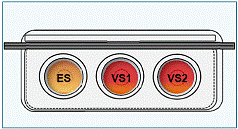
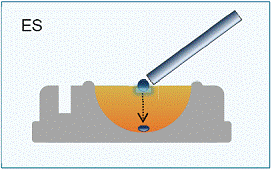
In this the Water molecules in the Embryo are replaced by Cryoprotectant. The cells shrink as the water comes out and re-expand as the cryoprotectant enters the embryo. (As shown in the images below).

Step 2 (Vitrification)
After 12 minutes, the Embryos are placed in a Vitrification solution and washed properly by transferring them to multiple drops to get rid of the Equilibration solution.
Within 90 sec, the Embryos are placed on the cryo-device and plunged into the liquid Nitrogen to vitrify them.
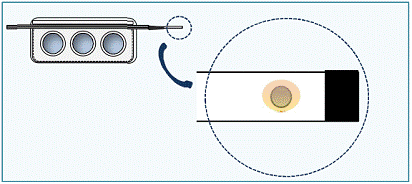
Loading embryos onto a cryo device is the most difficult part of the procedure. One must make sure that the volume of media should be as low as possible since the freezing medium has a high concentration of cryoprotectant and is embryotoxic, which can affect the survival of embryos.
The Cryodevices are placed in Visitubes and safely stored in Canisters of Liquid Nitrogen Cans.
The Storage and Identification details viz. The unique “Id number” of the patient, the Colour of the Cryodevice, the Colour of the Visitube, the Canister Number, and the Cryocan number are noted in the freezing register and software.
Which helps identification easier at the time of FET for thawing the Embryos.
Embryo Thawing (Warming / Devitrification)
Previously Frozen Embryos are thawed/warmed prior to the Embryo transfer in a Frozen Embryo Transfer (FET) cycle
Quick warming takes place in the devitrification/ warming of Vitrified Embryos (-196 de. cel to 37 deg. cel) in less than 1 min.which is followed by placing the embryos in different warming solutions, where Cryoprotectant in the embryo is replaced by water.
The warming/devitrification kit has 3 solutions.
Thawing Solution, Diluent Solution, and Washing Solution.

All 3 solutions are removed from the cold storage.
-Thawing solution is kept on the warmer or incubator (Preferably Overnight incubation) to heat up and bring the temperature to 37 degrees Celsius.
-Diluent solution (DS) and Washing Solution (WS) are brought to room temperature.
The Cryodevice with the Frozen Embryos to thaw is identified, removed, and kept ready in the small Liquid nitrogen box.

Warming (37 deg. Celcius)
The cap of the cryo-device is removed in the Liquid nitrogen and the device with the embryos /blastocysts is placed in the thawing solution at 37 degrees Celsius. and kept for 1 min.

Dilution (at Room Temperature)
After 1 min, the embryos are aspirated with flex pet and transferred to Diluent solution, and kept for 3 min.
After 3 min, the embryos are then transferred to a Washing solution (WS) and kept for 5 min.
After 5 min, the fully recovered embryos/blastocysts are shifted to 2nd drop of washing solution, rinsed properly, and transferred to the culture dish.
For how much time the Thawed Embryos are kept in the CO2 incubator before transferring them to the Uterus?
The Embryos/Blastocysts Post thaw and should be incubated for a few hours to stabilize before we can transfer them back to the uterus.
Typically, day 3 Embryos (8-cell Embryos) can be incubated for 1-2 hours prior to the Embryo Transfer.
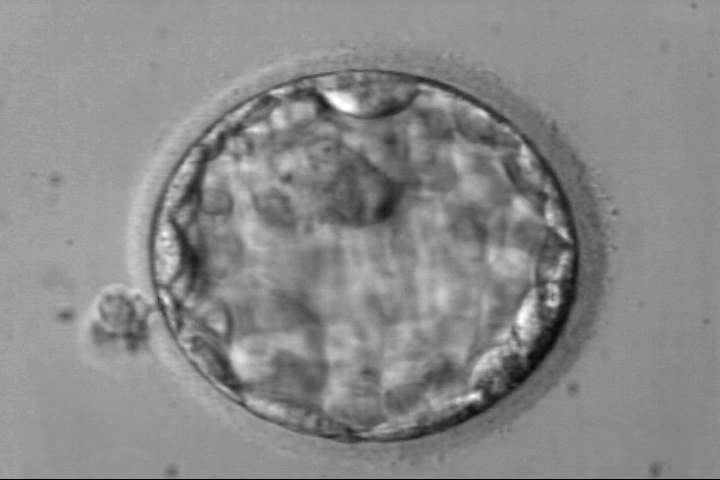
For day 5 Embryos (Blastocysts), it's always better to incubate for 3 hours or more, as it allows the blastocyst to re-expand.
| Pre- Freeze Picture | Post Thaw @ 0 Hours | Post Thaw @ 3 Hours |
|---|---|---|
 |
 |
 |