

Seven steps of IVF
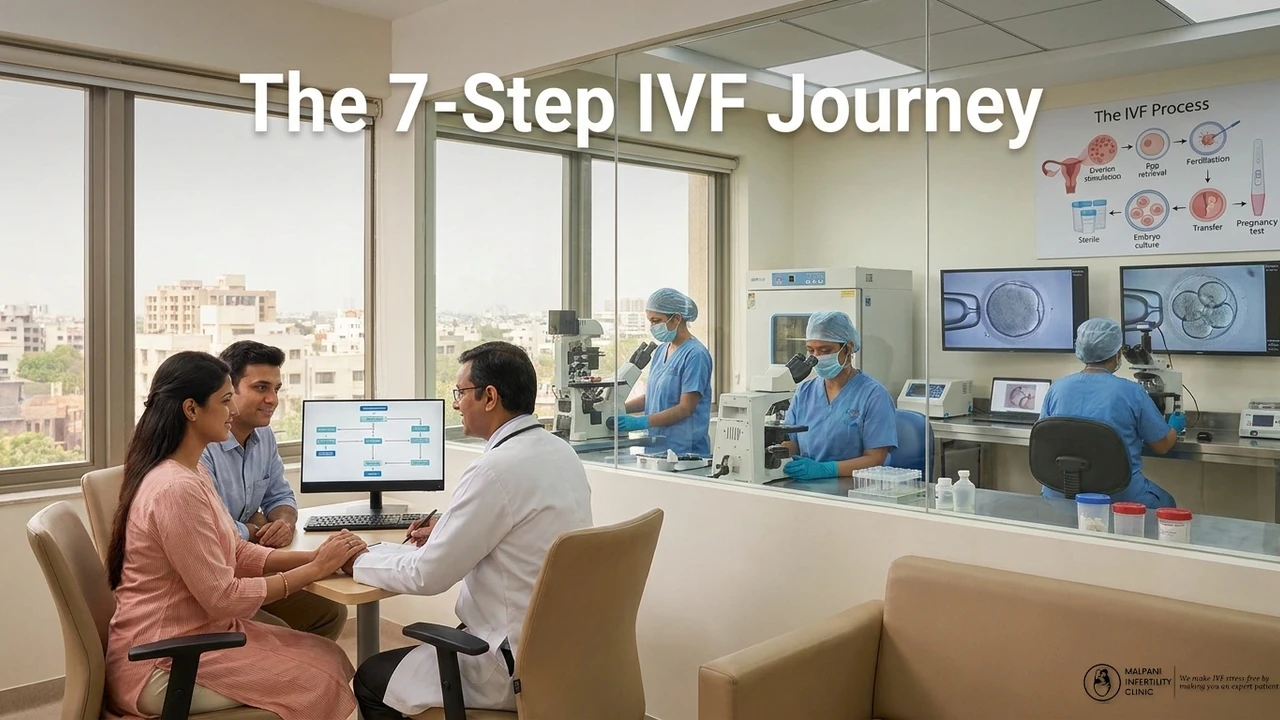
- IVF is emotionally challenging and often follows years of disappointment, but it provides a real, evidence-based chance for many couples to become parents.
- The IVF process begins with a personalized consultation and may include extra tests to tailor treatment to your specific needs.
- Ovarian stimulation involves daily injections for 10-12 days, but most women find these manageable after the first few days.
- The focus during IVF is on producing quality eggs, not just quantity, and your treatment plan should be individualized based on your body's response.
You wake up every morning with that same nagging question: Will this be the month? Maybe you have already faced months, or even years, of hope and heartbreak. Maybe you have been told that IVF is your next step, but the very word fills you with anxiety. What if it is too complicated, too painful, or just another disappointment? If these thoughts are running through your mind, you are not alone. At Malpani Infertility Clinic, we meet couples every day who feel exactly this way: overwhelmed, uncertain, and desperate for real answers that respect both their hearts and their minds.
The Emotional Weight of IVF
IVF is much more than a medical procedure. For most couples, it is the emotional culmination of years spent trying, waiting, and wishing. The decision to start IVF often comes after heartbreak, guilt, social pressure, and endless “what ifs.” It is normal to feel anxious about the unknowns. Will the medication work? Will I produce enough eggs? What if I do everything right and it still fails?
Here is what nobody tells you: IVF is not just about science. It is about courage, patience, and the willingness to hope again, even after hope seems impossible. At every stage, you deserve honesty and a guiding hand that will never sugarcoat the realities, but will always fight for your best chance.
IVF is not a magic wand, but it is a real, evidence-based pathway for many couples to finally become parents.
Step 1: The First Consultation
The journey starts with a frank, open conversation. When you meet Dr. Malpani or our team, we will review your entire history, previous tests, failed cycles, underlying medical concerns, and even the emotional toll this has taken. Honesty is crucial here. We want to understand your journey so far, your hopes, and your fears. Then, together, we develop a plan that fits you, not a one-size-fits-all protocol.
At this stage, we may recommend additional tests to check your uterus, ovarian reserve, and hormone levels. These are not just boxes to tick, they help us design a plan that gives you the highest chance of success, and they ensure we do not overlook anything important.
Step 2: Ovarian Suppression and Stimulation
Many people are surprised to learn that IVF does not start with egg retrieval. First, we need to prepare your body. Medications are given to gently suppress your natural cycle so we can control ovulation. After this, you will start fertility injections (usually for 10-12 days) to stimulate your ovaries to produce multiple eggs rather than just one.
- These injections may sound scary, but most women find them manageable after the first day or two.
- Your response will be closely monitored through ultrasound scans and blood tests.
- We adjust the plan depending on how your body responds, we never use a "cookie-cutter" approach.
Step 3: Monitoring and the Trigger Shot
Your progress is tracked through frequent ultrasounds and bloodwork. We look for growing follicles in your ovaries and check your hormone levels. When the eggs are ready, we time a special injection (called the “trigger shot”) to mature the eggs and schedule the egg retrieval for exactly 34-36 hours later. This timing is crucial, too early or too late can mean the difference between success and disappointment.
Step 4: Egg Retrieval
The egg retrieval itself is a short procedure, usually lasting less than 30 minutes. You are given light sedation so you feel no pain. Using ultrasound as a guide, a thin needle gently collects the eggs from your ovaries through the vagina. Most women are surprised at how quickly it is over, and you can rest at home the same day.
- Do not be afraid of this step. It is not as invasive or painful as you might fear.
- We will support you with honest answers and practical tips for a smooth recovery.
Step 5: Fertilization and Embryo Culture
In the laboratory, your eggs are mixed with sperm (from your partner or a donor) for fertilization. Sometimes a technique called ICSI (intracytoplasmic sperm injection) is used to give each egg the best chance. Our embryologists watch closely as embryos grow in special incubators for 3-5 days. Each day, we check for healthy development, cell division, quality, and other signs of viability.
We will keep you updated. You do not have to chase us for information. We know every embryo represents another hope, and we treat them, and you, with respect and transparency.
Step 6: Embryo Transfer
Once the embryos have reached the right stage, we select the best one(s) for transfer. This procedure is simple: a thin, soft catheter places the embryo into your uterus. You will not need anesthesia, and the process takes just a few minutes. Afterward, you can rest for a short while and then return home.
- How many embryos are transferred depends on your age, embryo quality, and previous history. We always discuss this with you in detail before transfer.
- If extra healthy embryos are available, we can freeze them for future attempts.
of our patients have extra embryos frozen for future use, giving more chances for a successful pregnancy without repeating the entire IVF process.
Step 7: The Wait and the Pregnancy Test
These are the hardest days. The “two-week wait” after embryo transfer is full of hope and anxiety. You may feel every twinge and wonder if it worked. You will have a blood test scheduled about two weeks after transfer to check for pregnancy. This is the moment that brings either tears of joy or, sometimes, more questions and decisions.
If the result is negative, we do not give up on you. We sit down and review everything, what worked, what did not, what can be improved. If it is positive, you begin the next stage of your dream: pregnancy.
IVF is not just about technology. It is about real people, real emotions, and the courage to try again.
What Makes Malpani Infertility Clinic Different?
At Malpani Infertility Clinic, we believe in empowering you with honest information and active participation in your care. We will never hide facts or give you false hope. Instead, we offer you the benefit of our decades of experience, the most advanced lab technology, and a team that truly listens to your anxieties and dreams.
Frequently Asked Questions
Q: How long does the full IVF process take?
A: From your first consultation to the pregnancy test, a typical IVF cycle lasts between four to six weeks. Each case is unique, so your doctor will share your exact timeline at your first visit.
Q: Does IVF hurt?
A: Most steps are not painful. The injections feel like a small pinch, and egg retrieval is done under sedation so you do not feel pain. Mild discomfort or bloating may occur, but serious pain is rare.
Q: How many embryos should be transferred?
A: This depends on your age, embryo quality, and previous IVF history. The goal is to maximize success while minimizing the risk of twins or higher-order multiples. This will be discussed in detail before your transfer.
Q: Can I freeze unused embryos?
A: Yes. Any high-quality embryos that are not transferred can be safely frozen for future use, which means you may not have to repeat the entire process if you want another child or if the first cycle is not successful.
Q: What if my IVF cycle fails?
A: It is difficult, but not the end. We always review the cycle in detail to understand what happened and discuss options for future attempts. Many couples succeed after more than one cycle.
Q: Will I get daily updates on my embryos?
A: We keep you informed at every significant stage and are always available to answer your questions. You do not have to worry about being left in the dark.