

Laparoscopy and laparoscopic surgery

If you have ever found yourself sitting in a clinic, having just been told you may need laparoscopy, your mind probably raced with worry. Is this the right step? Will it help me get answers about my fertility struggles? Could it finally shed light on the pain and confusion that has haunted my journey? You are not alone in these questions, and at Malpani Infertility Clinic, we believe patients deserve the full truth—no sugar-coating, no unnecessary procedures, only guidance that puts your health and your hopes first.
Laparoscopy: What It Really Is and Why It’s Offered
Laparoscopy—sometimes called keyhole surgery or minimally invasive surgery—lets doctors see inside your abdomen and pelvis by inserting a slim telescope-like camera through a small cut below your navel. This allows a direct look at your uterus, fallopian tubes, and ovaries. The goal: to find hidden causes of infertility, such as endometriosis, adhesions (scar tissue), blocked fallopian tubes, or pelvic infections like tuberculosis.
In the past, laparoscopy was almost routine for infertile women after basic tests. It was considered the gold standard for finding hidden issues, especially when other tests gave inconclusive answers. But things have changed. With better, less invasive diagnostics available, the need for laparoscopy has become much less common, especially at our clinic.
What Happens During a Laparoscopy?
Let’s talk through the real experience—because knowing what to expect helps you feel more in control. Before surgery, you’ll be asked not to eat or drink for several hours and may have some basic tests to make sure anesthesia is safe for you. The procedure is done under general anesthesia, so you will be asleep and feel no pain.
Your abdomen is cleaned and draped. A needle is inserted through a tiny incision, and gentle gas fills your belly to create space, so the camera can move freely and the organs can be seen clearly. The laparoscope is inserted below your navel. Sometimes, one or two more small cuts are made for other instruments, allowing the doctor to move or examine organs in detail. A harmless blue dye may be passed through your uterus and tubes to check if your tubes are open.
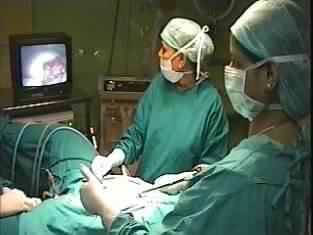 Fig 1. A laparoscopy being performed. Note that the view through the laparoscope can be seen on the TV monitor.
 Fig 2. Normal pelvis as seen during a laparoscopy. The uterus is the reddish structure in the center; on either side of which are the pink fallopian tubes. These run towards the ovaries, which are white in colour.
The doctor inspects everything carefully: the uterus, ovaries, fallopian tubes, and the lining of the pelvis. If something looks suspicious—like a cyst, endometriosis, or scar tissue—a biopsy or even treatment (such as removing the scar tissue or burning endometriosis spots) can be done right then and there.
Afterwards, the gas is let out, and the tiny cuts are closed with a stitch or a Band-Aid. Most women go home the same day and are back to normal activities in a few days.
Why We Rethink Laparoscopy at Malpani Infertility Clinic
Many patients arrive at our clinic confused and frustrated because previous doctors have recommended, or even performed, multiple laparoscopies—sometimes without much explanation. You deserve better. We have moved away from routine laparoscopy because, despite its usefulness in certain situations, it’s a surgery with real risks, real discomfort, and real costs. And in most cases, it doesn’t change what we would do next to help you conceive.
For most women, a simple HSG (hysterosalpingogram)—an X-ray test that checks if your fallopian tubes are open—is all that’s needed to plan the next steps. It is non-surgical, quicker, and keeps you in control. Even if laparoscopy detects things like mild endometriosis or small adhesions, research shows that removing these rarely improves fertility outcomes. That’s why we focus on tests and treatments that actually move you forward, not just add to your medical history.
Most women with infertility have normal-looking pelvises on laparoscopy, so doing it for everyone simply doesn’t make sense.
- Laparoscopy is still valuable if you have specific symptoms (like severe pain, a suspicious mass, or failed simpler tests), or if previous surgeries make your case unique.
- We always look for non-invasive options first and use laparoscopy only when it will clearly help you take the next meaningful step.
The Real Risks and Recovery After Laparoscopy
While laparoscopy is called "minimally invasive," it’s still a surgery. For you, and for every patient, any surgery feels major. Complications are rare—about three in a thousand young, healthy women—but they can include injury to the bowel, bladder, or blood vessels, infection, or bleeding. The risk goes up if you have had previous abdominal surgeries, infections, or if you are overweight.
After the procedure, it’s normal to feel:
- Mild nausea from anesthesia
- Shoulder or neck pain (from gas used during surgery)
- Soreness at the incision sites
- Cramps or muscle aches
- Temporary sore throat if a breathing tube was used
- Light discharge or mild swelling
Most of these symptoms fade within a day or two. You can usually return to work within three days, resume exercise and sex after a week, but always follow your doctor’s advice for your specific case.
If you notice heavy bleeding, severe pain, high fever, or anything that feels "not right," contact your doctor immediately. Your safety comes first—always.
Complication rate for laparoscopy in young, healthy women—making it a safe procedure but not without risk.
Laparoscopy vs HSG: Which Is Right for You?
This is a question we hear every week. Here’s the honest answer: HSG is less invasive, less expensive, and gives us a permanent record of your tube status. Laparoscopy lets us see things HSG cannot (like mild endometriosis or scar tissue outside the tubes), but these rarely change our recommended next steps. Sometimes, both tests are needed—especially if your tubes look blocked on HSG, or if you have symptoms that do not match your test results.
Be careful if a doctor suggests repeating laparoscopy without a clear reason. Unnecessary surgeries add risks, costs, and stress. Ask questions, and demand clear answers: What will you learn from repeating this? How will it change my treatment? If you do not get a convincing answer, it’s okay to say no.
What Happens After Laparoscopy? What Should You Ask?
Your follow-up visit is crucial. Make sure your doctor explains exactly what was found and how it affects your chances of conception. There are three main possibilities:
- Everything looks normal: This is the most common outcome and can actually be good news. It means your infertility is unexplained, and you can focus on the next steps (such as IUI or IVF) without worrying about hidden problems.
- Abnormal findings that can be treated during laparoscopy: If mild endometriosis or adhesions were found and removed, your doctor may monitor your progress or repeat a simple test (like HSG) after a few months to check if things have improved.
- Findings that cannot be fixed surgically: For example, if your tubes are badly damaged, IVF may be the better and safer next step.
Don’t let a diagnosis like "small fibroid" or "simple cyst" scare you into more surgery. Many of these findings are harmless and don’t affect fertility. Removing them can sometimes do more harm than good.
Making Informed Choices: How Malpani Infertility Clinic Supports You
At Malpani Infertility Clinic, we won’t push you toward surgery unless you truly need it. We believe in transparency, and we want you to understand every step of your journey. If you are ever unsure, or if you’ve been told you "need" a laparoscopy without a clear explanation, let’s talk. We encourage our patients to ask tough questions, seek second opinions, and make decisions based on evidence—not emotion or pressure.
Sometimes, laparoscopy is the right choice. But most of the time, there are gentler, safer paths that bring you closer to your dream of a family. We’re here to help you find them.
Frequently Asked Questions
Q: Is laparoscopy always necessary for infertility diagnosis?
A: No, it’s not always needed. Most women can be evaluated with less invasive tests like HSG. Laparoscopy is reserved for specific cases where it will clearly influence your treatment plan.
Q: What are the main risks of laparoscopy?
A: While complications are rare, there is a small risk of injury to abdominal organs, bleeding, infection, or problems from anesthesia. Always discuss your individual risk with your doctor.
Q: How soon can I return to work or normal activities after laparoscopy?
A: Most women return to work within 2–3 days and resume normal activities in about a week, depending on how they feel and their doctor’s advice.
Q: Can laparoscopy treat infertility?
A: Laparoscopy can treat certain causes of infertility (like endometriosis or adhesions) if found, but it does not guarantee improved fertility—and often, these treatments aren’t needed unless you have severe symptoms.
Q: Should I agree to repeat laparoscopy if a previous one was normal?
A: Not without a clear medical reason. Always ask what new information is expected and how it will change your treatment. Unnecessary repeats should be avoided.
Q: Can I get a video or record of my laparoscopy?
A: Yes, modern laparoscopies are often recorded and you have the right to request a copy for your records or for a second opinion.