
Symptoms of Endo. Treating Endometriosis -- The Silent Invader
Waking up each month, dreading the pain that comes with your period. Worrying when cramps start earlier than usual or last long after your period ends. Feeling guilty for missing work or social events. Wondering if anyone else understands this silent struggle. And behind it all, the nagging fear: Will this pain steal my chance to have a baby? If these thoughts sound familiar, you are not alone. Endometriosis is a hidden burden for millions of women, yet most go years without a clear answer. At Malpani Infertility Clinic, we see you. We believe every woman deserves real answers, not just sympathy.
Understanding Endometriosis
Endometriosis, often called "endo", is a condition where tissue similar to the lining of your uterus starts growing outside it. This can happen anywhere inside your pelvic area: on the ovaries, fallopian tubes, or even the intestines. Each month, this tissue responds to your hormones just like the lining in your uterus would. But unlike normal menstrual blood, there is no natural exit for this trapped blood and tissue. The result? Inflammation, irritation, and sometimes severe scarring inside your body.
You might have heard endometriosis called a "career woman's disease" because it is often found in women who have delayed pregnancy. The truth is: endometriosis can affect anyone of reproductive age, regardless of lifestyle or life choices.
What makes endometriosis so confusing is how unpredictable it is. For some women, it remains mild and barely noticeable. For others, it spreads, forming webs of scar tissue called adhesions that can literally tie organs together. Many women experience no symptoms, while others face relentless pain or infertility.
It is often called an "enigma wrapped inside a mystery". At Malpani Infertility Clinic, we are dedicated to helping you unravel it.
What Causes Endometriosis?
Doctors still debate exactly why endometriosis happens. One widely accepted theory is "retrograde menstruation": instead of all menstrual blood flowing out, some flows backward through the fallopian tubes into the pelvis, carrying endometrial cells with it. These cells can then stick to pelvic surfaces and start growing where they do not belong.
Other ideas include genetics, immune system issues, or even the spread of endometrial cells through blood or lymphatic channels. The bottom line: none of these are your fault. You did not cause this, and you do not have to fight it alone.
What Does Endometriosis Look Like?
Endometriosis can appear in several forms inside the body:
- Early spots look like tiny dark blue or black flecks, often called "powder-burn" marks.
- It can invade the ovary, creating blood-filled cysts called endometriomas. Over time, the trapped blood turns thick and dark, earning them the nickname "chocolate cysts."
- Scar tissue may form, binding together the uterus, ovaries, tubes, or even the intestines.
- In rare cases, tissue can grow deep into the intestinal walls, but endometriosis is not cancerous.
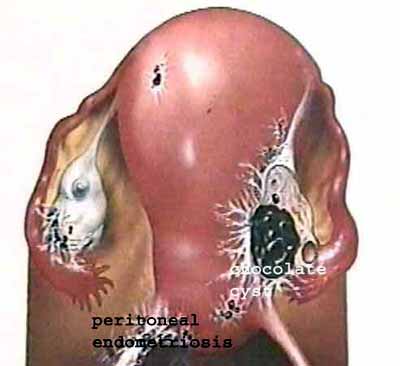 Fig 1. Schematic, showing a chocolate cyst (endometrioma) in the right ovary and peritubal adhesions because of endometriosis
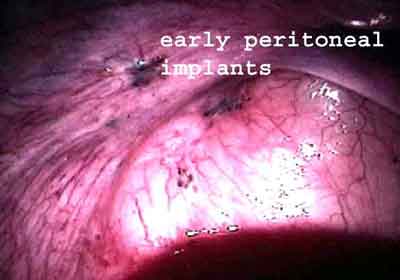 Fig 2. Laparoscopy, showing minimal endometriosis, in the form of "powder-burn" deposits.
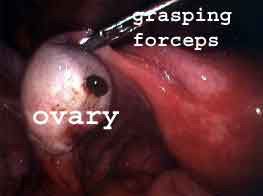 Fig 3. Laparoscopy, showing a small chocolate cyst in the left ovary. This can be very easy to miss, so a careful multiple puncture laparoscopy is essential to make an accurate diagnosis of endometriosis.
Symptoms: Why Endometriosis Is Called the Silent Invader
Endometriosis does not always announce itself. Some women have severe scarring and almost no pain. Others have mild disease but struggle with disabling symptoms. The most common signs include:
- Increasing menstrual pain (dysmenorrhea) that starts earlier, lasts longer, or is more severe than before
- Pain during intercourse (dyspareunia), especially with deeper penetration
- Occasional irregular or premenstrual spotting, but most women have normal menstrual cycles
- For some, unexplained infertility is the only clue
It is important to know: the degree of pain does not always match the severity of disease. Some women with widespread endometriosis feel fine. Others feel miserable with just a few small spots.
Many women spend years hearing that their pain is "normal" or "all in your head". A real diagnosis can be a huge relief: your pain has a name, and you are not alone.
How Endometriosis Affects Fertility
If you are struggling to get pregnant, you might be wondering: is endometriosis the reason? The answer is complicated, but here is what we know.
Endometriosis can affect fertility in several ways:
- It creates inflammation in the pelvis, which can disrupt how eggs develop, how sperm and egg meet, and even how an embryo implants.
- Scar tissue or adhesions can physically block or trap the ovaries and tubes, making it difficult for the egg to be released or picked up.
- Large chocolate cysts in the ovaries can harm ovulation by damaging healthy ovarian tissue.
- Sometimes, endometriosis is simply present along with other fertility problems, like sperm quality or ovulation issues. It may be a "red herring" rather than the main cause.
Some women with endometriosis get pregnant easily. Others struggle, especially if there are adhesions, cysts, or other factors involved. What matters is building a plan that fits your unique body and history.
Diagnosing Endometriosis: Finding Answers
If you have classic symptoms, an experienced doctor may suspect endometriosis based on your history alone. For many women, finally having a diagnosis is both a relief and a shock. Relief, because the pain is real and has a name. Shock, because a Google search brings up scary complications and worst-case scenarios.
The good news: endometriosis is not cancer and there are modern, effective treatments available. At Malpani Infertility Clinic, we focus on helping you find the best path forward, not just a label.
Laparoscopy (a keyhole surgery to look inside the pelvis) used to be the gold standard for diagnosing endometriosis. It let doctors directly see and "stage" the disease. But because it is surgery, many specialists now prefer less invasive approaches first, especially for women dealing with infertility.
Ultrasound is excellent for spotting chocolate cysts in the ovaries, even when they are small. On a scan, these show up as complex masses (both fluid and solid parts) and can be tender. However, ultrasound cannot always spot tiny deposits or confirm endometriosis unless the cyst is aspirated and the typical thick, dark blood is found. Sometimes, a laparoscopy is still needed for a firm diagnosis, especially if other causes are possible.
Treatment Options: What Really Works?
Treating endometriosis is about managing symptoms, improving quality of life, and protecting your fertility. There is no magic cure, but there are several effective strategies. The right choice depends on your symptoms, age, fertility goals, and ovarian reserve.
Medications for Endometriosis: What You Need to Know
Hormonal treatments aim to mimic pregnancy or menopause, both states where endometriosis shrinks on its own. Common medications include:
- Birth control pills: Taken continuously, these can create a "pseudopregnancy" state, stopping periods and helping with pain.
- Danazol: Suppresses estrogen to induce a "pseudomenopause," but is expensive and not helpful for large cysts.
- GnRH analogues (like Lupron or Synarel): These switch off hormone production, also creating a menopause-like state, but are given as monthly injections.
Be aware: These medications are not recommended for women trying to get pregnant. They pause ovulation and do not improve fertility rates. If your goal is to have a baby, medications may only delay more effective options.
Surgical Treatment: When and Why?
Medicines have limits. They can help with pain or shrink small spots, but cannot remove scar tissue or large cysts. Surgery can help in certain cases, especially if there are adhesions, endometriomas (chocolate cysts), or nodules causing pain or blocking organs.
Most surgeries are done by laparoscopy (keyhole surgery), where the surgeon can drain cysts, free adhesions, and remove endometriosis patches with precision. Open surgery is rarely needed. However, not every woman with endometriosis needs an operation, especially if you are trying to preserve your ovarian reserve and future fertility.
Overenthusiastic surgery can sometimes do more harm than good, especially if healthy ovarian tissue is removed along with the cyst wall. That is why it is vital to check your ovarian reserve before any surgical plan.
We recommend testing your AMH level (a simple blood test showing your egg reserve) before agreeing to any surgery. This is especially important if:
- You are over 35
- You have had surgery for cysts before
- You have large or recurrent chocolate cysts
- You are worried about poor egg reserve (sometimes called oopause)
If your AMH is low or FSH is high, surgery may lower your fertility further. In many cases, it is better to move directly to IVF or fertility treatments.
If you do have a cyst, it can sometimes be treated by draining it under ultrasound guidance rather than surgery, which helps preserve your ovarian function.
IVF and Other Fertility Treatments
Endometriosis cannot be "cured," but it can be controlled, and many women go on to have healthy pregnancies. If you have tried surgery or other treatments and still struggle to conceive, advanced fertility treatments like superovulation with intrauterine insemination (IUI) or in vitro fertilization (IVF) can help.
Be aware: Some women with endometriosis may have a weaker ovarian response to IVF, especially after surgery for large cysts. Fertilization rates can sometimes be a bit lower, possibly due to egg quality. That is why choosing the right clinic and protocol matters.
of women with mild to moderate endometriosis become pregnant within 3-5 IVF cycles at experienced clinics like Malpani Infertility Clinic.
The choice between further surgery and moving to IVF is not always straightforward. While some doctors push for more surgery, research shows that unnecessary operations can actually reduce your chances. What matters most is protecting your ovarian reserve and choosing a treatment path that fits your body and your dreams.
Finding the Right Support
Endometriosis is not just a medical problem, it is an emotional one. The pain, the uncertainty, the endless appointments, and the confusion about what to do next can feel overwhelming. But you do not have to navigate it alone.
At Malpani Infertility Clinic, we believe in empowering you with facts, not false promises. We will help you understand your options, protect your chances for a healthy pregnancy, and give you the support you need, whether that means surgery, IVF, or simply advice on next steps. If you feel lost or need a second opinion, consider reaching out to discuss your personal situation with Dr. Malpani. Sometimes, just having a knowledgeable, no-nonsense guide can make all the difference.
Frequently Asked Questions
Q: What are the classic symptoms of endometriosis?
A: Symptoms include increasing menstrual pain, pain during intercourse, and sometimes irregular bleeding or spotting. Some women have no symptoms at all and only discover endometriosis during fertility testing.
Q: Can endometriosis cause infertility even if I have mild symptoms?
A: Yes. Fertility can be affected even if the disease is mild or symptoms are minimal. It depends on factors like inflammation, adhesions, and egg quality.
Q: Should I have surgery or move directly to IVF?
A: This depends on your age, ovarian reserve (AMH), previous surgeries, and the size of any cysts. If your ovarian reserve is low, IVF may be the better first option.
Q: Will treating endometriosis cure it permanently?
A: There is no permanent cure, but treatments can control symptoms and improve your chances of conception. Recurrence is possible, but many women go on to have successful pregnancies.
Q: Is endometriosis a cancer or does it increase my risk of cancer?
A: Endometriosis is not cancer and does not usually lead to cancer. It is a benign but sometimes aggressive condition that needs careful management.
Q: How do I know if I have poor ovarian reserve?
A: A blood test for AMH (Anti-Müllerian Hormone) and FSH (Follicle Stimulating Hormone) can give you a good idea of your egg reserve. Low AMH or high FSH suggest lower reserve.
Q: Can I get pregnant naturally if I have endometriosis?
A: Many women with endometriosis conceive naturally, especially if the disease is mild. If you have been trying for over a year without success, seek expert advice.