

IVF - Part 2 - More about Test Tube Babies. Egg retrieval. Fertilisation. Embryo Culture
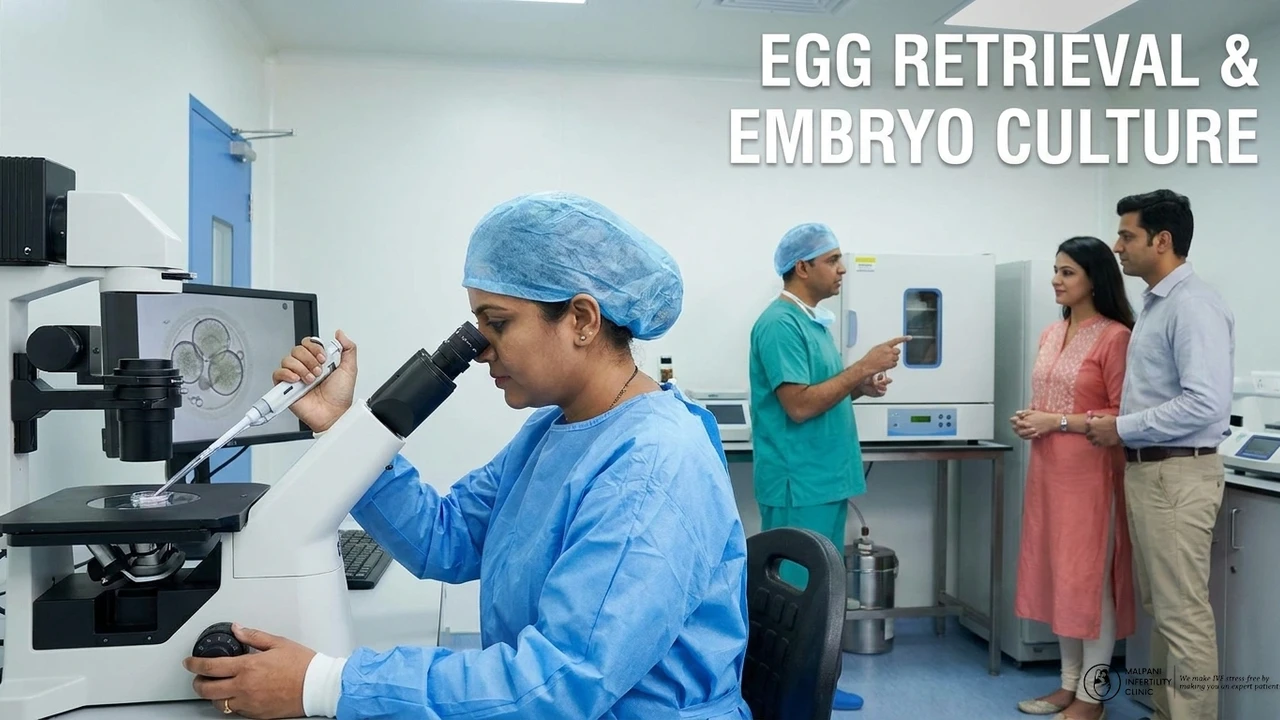
You are sitting in the clinic’s waiting area, heart pounding, hands cold, replaying the words your doctor said: “IVF is the next step.” Maybe you have already tried everything else, and the disappointment has worn a groove in your life. Maybe you are scared, or maybe you are hopeful, or maybe, like most people, both at once. What actually happens in the lab? Will your eggs and sperm be safe? Will they really become embryos? Will this work for you? If you are searching for clarity and real answers about what happens during IVF, the egg retrieval, fertilisation, and embryo culture, this article is for you.
Egg Retrieval: What Really Happens
You have made it through the daily injections, the scans, the blood tests. Now comes the day you have been counting down to with a mix of anxiety and cautious hope: egg retrieval. At Malpani Infertility Clinic, we believe that your comfort and safety come first. That’s why we carry out egg retrieval under general anesthesia, so you do not feel pain, and we can focus on getting as many healthy eggs as possible.
Here is how it works: The doctor gently inserts an ultrasound probe into the vagina. The probe shows the ovaries and the follicles, little black bubbles, on a monitor. Using this live image, a fine needle is guided through the vaginal wall into each follicle. The fluid, which contains the egg, is drawn out and collected in test tubes. Each follicle is aspirated one by one, with immense precision. Depending on the number of follicles, this process takes about 10 to 40 minutes.
On average, we retrieve between 4 and 16 eggs per patient. If there are only a few, we flush each follicle to make sure we do not leave any eggs behind.
The old days of using laparoscopy for egg retrieval are long gone. Today’s ultrasound-guided approach is safer, less invasive, and much quicker.
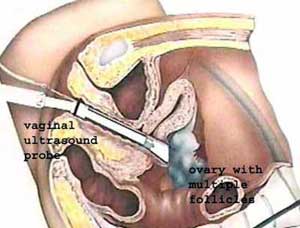 Fig 1. Schematic of egg collection under vaginal ultrasound guidance. If you click on the picture, you can watch a video of an actual egg retrieval procedure done in our clinic
What Happens in the IVF Lab?
Once the eggs are collected, the clock starts ticking. The test tubes are swiftly transported to the IVF lab, which sits right next to the operating theatre. In the lab, an embryologist, someone you may never meet, but who plays a crucial role, examines the follicular fluid under a special stereozoom microscope. The goal: to find every single egg, which at this point is called an oocyte-cumulus complex (the egg surrounded by a cluster of sticky cells).
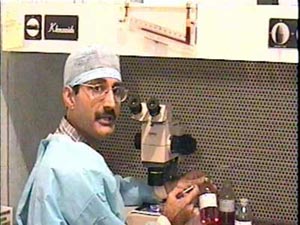 Fig 2. Checking the eggs under the stereozoom microscope in the IVF lab. If you click on the picture, you can watch a video of an actual egg retrieval procedure done in our IVF laboratory
 Fig 3. Mature oocyte cumulus complex, as seen under a stereozoom microscope in the IVF lab, during egg retrieval. The egg is in the center, surrounded by the cumulus cells.
The eggs are carefully washed, graded for maturity, and gently placed in a special incubator, the “womb” of the IVF lab. The timing of insemination (adding sperm to the eggs) is based on how mature the eggs are. Usually, the sperm are added within 2 to 6 hours after retrieval.
On this same day, known in the lab as Day 0, your partner provides a semen sample. For many men, this can be a stressful moment and sometimes, in the pressure of the situation, it is difficult to produce a sample. If this is a worry for you, do not panic: we can use a previously frozen sample or even help with medication or devices if needed.
The sperm are separated from the rest of the fluid in a process called “washing.” Then, a measured number of sperm (typically about 100,000 per milliliter) are placed with each egg in a dish filled with IVF culture medium. This medium is like “chicken soup” for embryos, full of proteins, salts, and all the nutrients they need to thrive.
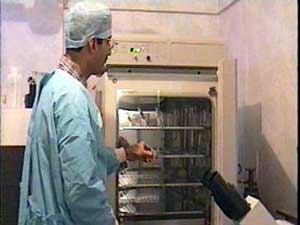 Fig 4. A view of the incubator - the heart of an IVF lab.
Fertilisation: The Moment of Truth
About 18 hours after the sperm and eggs have been mixed (now Day 1), the embryologist checks to see if fertilisation has occurred. This is called a pronuclear check. A fertilised egg will show two tiny bubbles (pronuclei) inside, a sign that the genetic material from both parents has combined to form a unique embryo.
 Fig 5. A normal 2-PN embryo on Day 1 (about 18 hours after egg retrieval). This is a good quality embryo, because the two pronuclei (the clear bubbles in the center) are touching each other and the pronucleoli they contain are aligned properly.
The hours leading up to this result are filled with suspense for every couple. No matter how good the eggs and sperm look, fertilisation is not something anyone can guarantee. Sometimes, unexpectedly, none of the eggs fertilise. This is devastating, but it is important to know that it is not your fault. Poor fertilisation can be related to the sperm, the egg, or rarely, lab conditions. If you are the only one with poor fertilisation that day in a good lab, it is usually a sperm issue.
The agonising wait for the fertilisation update is something every IVF patient remembers. You are not alone in feeling anxious about this stage.
Embryo Culture: Growing Your Embryos
The embryos that have fertilised normally are left in the incubator to divide and grow. On Day 2 (about 48 hours after retrieval), a good quality embryo will have 2 to 4 cells, all similar in size and shape, with clear cytoplasm and few fragments. By Day 3, they reach the 8-cell stage, and by Day 5, the best embryos become blastocysts, ready for transfer.
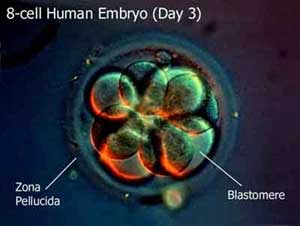 Fig 6. A beautiful 8-cell embryo on Day 3 (about 72 hours after egg retrieval). This is a Grade A embryo, with regular, equally sized, clear blastomeres, and no fragments.
The IVF lab is truly the heart of any good clinic. The skill and dedication of your embryologist matter as much as the doctor who meets you in the clinic. At Malpani Infertility Clinic, our embryologists follow strict quality control protocols to prevent any mix-up of eggs, sperm, or embryos. Errors are extremely rare in a well-run lab, and you should feel reassured by the safety checks we have in place.
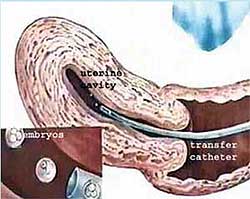 Fig 7. Schematic of embryo transfer. The embryos are gently deposited in the uterine cavity
After 2-3 days, embryos used to be transferred into the uterus. Today, we often prefer to grow embryos to Day 5 (blastocyst stage) before transfer, as this is linked to a higher chance of pregnancy.
of eggs and embryos are safely handled without any mix-up or error in labs with strict protocols like ours.
For a detailed look at the next steps, embryo transfer and implantation, you can read more at https://www.drmalpani.com/knowledge-center/resources/books/chapter25c.
What No One Tells You About IVF
IVF is an emotional rollercoaster. There are days when you will feel quietly hopeful and days when you are convinced nothing will work. The science is remarkable, but so is the human struggle. If you worry about what happens behind the scenes, or whether your eggs and embryos will be safe, know that you are not the only one.
At Malpani Infertility Clinic, we believe knowledge is power: we take the time to explain every step, answer every question, and support you through the process. Our goal is not just to get you pregnant, but to help you make the best decisions for your own unique fertility journey.
If you need more details, or want to know how these steps apply to your situation, you can reach out for a confidential chat with Dr. Malpani or a fertility advisor.
Frequently Asked Questions
Q: How long does the egg retrieval process take?
A: The procedure typically takes about 10 to 40 minutes, depending on the number of follicles. Most patients are able to go home the same day.
Q: Will egg retrieval be painful?
A: At Malpani Infertility Clinic, we use general anesthesia for egg retrieval, so you will not feel any pain during the procedure. Mild discomfort or cramping may be felt afterwards, similar to period pain.
Q: What happens if my eggs or sperm do not fertilise?
A: Sometimes, despite everything looking perfect, fertilisation does not occur. This can be due to egg or sperm issues, and it is not your fault. Your doctor will discuss next steps and possible changes for future cycles.
Q: How does the clinic ensure that my eggs, sperm, or embryos are not mixed up?
A: Reputable clinics like ours use strict identification protocols and double-checking at every step to prevent any mix-ups. Such errors are extremely rare in well-run labs.
Q: How many embryos are usually transferred?
A: The number of embryos transferred depends on your age, embryo quality, and other factors. Your doctor will guide you on the safest and most effective option for you.
Q: Can I speak to the embryologist about my embryos?
A: Absolutely. At Malpani Infertility Clinic, we encourage patients to ask questions and understand what happens in the lab. Your peace of mind matters.
Q: What happens to unused embryos?
A: High-quality unused embryos can be frozen (cryopreserved) for future use, in case you want to try for another child or if this cycle does not succeed.