

Overview of the Embryo Transfer & Implantation | How to maximize your chances of IVF success ?

You have made it through injections, scans, and more waiting rooms than you ever imagined. Now, you are at the point where everything comes down to one thing: embryo transfer. If you find yourself lying awake at night, replaying every step, wondering if you have done everything right, or feeling the weight of hope and fear in equal measure, you are not alone. So many couples at this stage share your mix of excitement and anxiety. It is okay to admit how much you want this, and it is okay to feel scared. Let us walk through what really happens during embryo transfer and what you can (and cannot) do to give yourself the best chance of success.
How Embryo Transfer Is Done
Embryo transfer is a gentle, straightforward procedure, usually done without any anesthesia. In most clinics, you will be asked to lie on a comfortable table while your doctor carefully inserts a thin, flexible tube, called a catheter, through your cervix and into your uterus. The embryos, suspended in a drop of nourishing liquid, are gently placed exactly where they need to be.
 Fig 1. Ultrasound-guided embryo transfer. The air bubble echo confirms accurate placement of the catheter in the uterine cavity
The whole process takes about 10 to 20 minutes. Some clinics use ultrasound guidance to make sure the embryos are placed in the optimal spot. Most women describe the experience as similar to a Pap smear, uncomfortable, but not painful. Afterwards, a short period of rest is often advised, but you usually do not need to stay in the clinic for long.
One question everyone asks is: how many embryos should be transferred? There is no simple answer. More embryos can increase your chance of pregnancy in a single cycle, but also raise the risk of twins or higher-order multiples. In some countries, legal limits apply. In India, the decision is highly individual and should be made after a frank discussion with your doctor about your age, embryo quality, and your feelings about multiples.
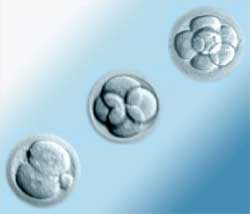 Fig 2. 3 Grade A embryos. These have 2-cells, 4-cells, and 8-cells respectively
Embryos are graded based on how they look and how many cells they have divided into. The best ones are called Grade A: they have four to eight cells of equal size, look clear, and show very little fragmentation. But remember, even lower-grade embryos can result in healthy babies. What matters is that you are given clear information. Always ask your clinic for photos of your embryos. Good clinics, including ours, do this routinely, these images are proof of the care you have received. If you are denied these, consider it a red flag.
If every embryo became a baby, we would only ever transfer one.
At Malpani Infertility Clinic, we do not hide the truth: despite cutting-edge technology, we cannot predict with certainty which embryo will become your child. This is why the decision on how many embryos to transfer is so personal. We will guide you, but you make the final choice, so you never look back with regret.
If your cycle produces extra embryos, these can often be frozen for future attempts, giving you more chances without repeating the entire process.
The Days After Embryo Transfer
You have done your part. Now comes what many call the hardest part: the two-week wait, or “2ww.” These days stretch forever, filled with hope and dread. Every twinge or spot of blood can send your mind racing. The truth? There are no secret symptoms that can tell you if you are pregnant. The outcome depends on many factors beyond your control.
During this time, your doctor will likely prescribe “luteal phase support”: estrogen and progesterone, which help create the right environment for implantation. About 10 to 14 days after transfer, a simple blood test (beta HCG) will tell you if implantation has occurred. Anything above 10 mIU/ml is considered positive. If it is, we will monitor you closely to confirm a healthy pregnancy and see if more than one embryo has implanted.
- No tub baths or swimming for 48 hours after transfer.
- Avoid douching or using tampons.
- No intercourse or orgasms until a fetal heartbeat is confirmed, or you get a negative pregnancy test.
- Steer clear of heavy lifting or strenuous exercise, gentle walks are fine.
- Return to light activity after 24 hours of rest. You can resume work, but listen to your body.
If you are unsure about any activity, ask yourself: “If I do this and do not get pregnant, will I blame myself?” If the answer is yes, skip it.
You may notice spotting or bleeding before your blood test, do not assume your period has started. Always do the test. Remember, there are no reliable symptoms or signs of early pregnancy at this stage.
Coughing, sneezing, or even getting up will not cause your embryo to “fall out.” Once placed inside, it is safe and secure.
Strict bed rest is not necessary, and can even increase your stress. The uterus is designed to keep embryos safe whether they arrive through sex or through a transfer. Try to carry on with life as normally as possible.
Why Some Embryos Do Not Implant
After all this effort, it is heartbreaking when a cycle does not work. Many women blame themselves, thinking their bodies have “rejected” the embryo or that they did not rest enough. The reality is much more complex.
Embryo implantation is a delicate dance between the embryo and the lining of the uterus (endometrium). First, the embryo must develop into a blastocyst and “hatch” out of its protective shell.
 Fig 3. Hatched blastocyst.
The uterus and embryo must then communicate using chemical signals so the embryo can attach and burrow in. This process, called apposition, adhesion, and invasion, happens during a short “implantation window.” Even in nature, this process is surprisingly inefficient. In IVF, only about 10 percent of transferred embryos actually implant.
is the average embryo implantation rate after IVF
A major reason for failure is that many embryos, even those that look perfect, have genetic abnormalities. Science is still working to unlock the mysteries of implantation. No one, not you, not your doctor, can control or predict this perfectly.
So if your cycle does not work, please do not blame yourself. It is not because you walked too much, coughed, or did not eat a superfood. Implantation depends on the embryo’s genetics and the complex, invisible dialogue with your body.
What Can You Do to Improve Your Chances?
There are no magic tricks, but there are a few practical steps for both women and men to support the process and avoid unnecessary regrets:
- If you need medication for any reason during this time, take it. Until your pregnancy test is positive, medications will not reach the embryo in significant amounts.
- Avoid smoking and alcohol. Studies show these can lower success rates and increase miscarriage risk.
- Limit caffeine to no more than two cups a day.
- Stick to a healthy, balanced diet, no need for drastic changes.
- Skip hot tubs and saunas.
- For men: avoid drugs, alcohol, and smoking. If you are providing a sperm sample, abstain from ejaculation for at least three (but not more than seven) days beforehand. For ICSI cycles, this is less relevant since only a single sperm is needed.
Try to focus on self-care, emotional support, and being kind to yourself. Surround yourself with people who understand. If you need a reality check or straight answers, know that at Malpani Infertility Clinic, we do not sugarcoat things. We help you understand what is in your hands, and what is not, so you can move forward with confidence, no matter the outcome.
Understanding IVF Costs
The cost of a single IVF cycle at Malpani Infertility Clinic is US $4000. Make sure to ask your clinic for a clear, itemized breakdown. Some may leave out costs for scans or extra procedures, which can add up. Also consider travel, time off work, and the emotional investment. If you need more than one cycle, the total cost can be higher.
Some couples opt for “natural cycle IVF,” which means no hormone injections are used, making the process cheaper. However, only one egg is usually retrieved, so the success rate per cycle is lower. Newer techniques like in vitro maturation (maturing eggs in the lab) are also available, but may not be suitable for everyone.
Frequently Asked Questions
Q: How long does embryo transfer take and is it painful?
A: The transfer itself usually takes 10 to 20 minutes. Most women describe it as slightly uncomfortable, but not painful, similar to a Pap smear.
Q: Is strict bed rest necessary after embryo transfer?
A: No, strict bed rest is not needed. Light activity is safe after a short rest. There is no evidence that physical activity affects embryo implantation.
Q: How many embryos should I transfer?
A: This depends on your age, embryo quality, and your feelings about twins or triplets. More embryos can mean a higher chance of success, but also a greater risk of multiples. Discuss your options openly with your doctor.
Q: Can I tell if I am pregnant before the blood test?
A: No, there are no reliable symptoms in the two weeks after transfer. Only a blood test can confirm pregnancy.
Q: Why did my embryos not implant even though they looked perfect?
A: Many embryos that look normal have subtle genetic abnormalities. Implantation is a complex process, and even in nature, it is inefficient. You are not to blame if it does not work.
Q: What is the cost of IVF at Malpani Infertility Clinic?
A: The cost is US $4000 per cycle, but you should always ask for a detailed breakdown and factor in travel and any additional procedures.
Q: Can I travel after embryo transfer?
A: It is safe to travel two to three days after the transfer. Just avoid heavy lifting and strenuous journeys for the first 48 hours.