

IVF success rates , blastocyst transfer , and simplifying IVF

Maybe you have spent months or even years hoping for those two pink lines, only to feel your heart sink each month. You have read success stories and statistics, and now you are trying to make sense of IVF success rates, embryo transfers, and all the medical terms that seem to swirl around your head with every consultation. It is tough, confusing, and often lonely. You are not alone in feeling overwhelmed or even skeptical about what you are told. Let’s talk honestly about what these numbers mean, what truly impacts your chances, and how you can make clear, personal decisions with the right advice by your side.
Understanding IVF Success Rates
Most couples want to know just one thing: What are our real chances of having a baby with IVF? It is the most natural question, but the answer is not as simple as a single percentage. So much depends on your specific situation.
- Your age: Fertility drops as you get older, especially after 40.
- Your diagnosis: Whether it is male factor, unexplained infertility, or tubal issues, each changes the odds.
- The clinic’s experience: Not all labs or teams are the same. Lab quality and the skills of the embryologist matter.
- The number and quality of embryos transferred: More embryos can mean more chances, but also higher risk of twins or triplets.
- The treatment protocol: The type of ovarian stimulation and timing of transfer can influence results.
Some factors, like age, are out of our hands. But others, like the clinic you choose or the way embryos are cultured and selected, can make a real difference. At Malpani Infertility Clinic, we don’t just quote numbers. We show you how we arrive at them, so you can see your path clearly.
Typical IVF pregnancy rates per cycle for women under 35, but remember: your individual chance may be higher or lower depending on your own factors.
It is crucial to look beyond that single “per cycle” number. IVF is rarely a one-shot affair. Most couples need to be prepared to undergo several cycles for a fair chance. For example, if a clinic’s success rate per cycle is 30%, after four cycles, the cumulative chance of pregnancy rises to about 70%, because each attempt is a new opportunity, not a penalty for past failures.
“Your odds are not reset to zero after every failed cycle. Each attempt is a new roll of the dice, and persistence pays off.”
But here’s the honest truth: for every couple who succeeds, it is 100% joy; for those who do not, it can feel like 0%. That is why we encourage our patients to plan for a series of cycles, emotionally as well as financially, and to know when it feels right for you to pause or stop.
The Reality Behind Clinic Success Rates
Not all IVF clinics report their results the same way. Some boast about high “pregnancy rates,” but what does that really mean? Is it a positive blood test, an embryo seen on ultrasound, or a live baby in your arms? Always ask for the take-home baby rate, the number of babies born per treatment cycle, because that is what really matters to you.
Here are ways some clinics might make their rates look better than they are:
- Counting only positive pregnancy tests, not live births.
- Including biochemical pregnancies (where the embryo did not develop).
- Selecting only younger or healthier patients for their statistics.
- Not reporting failed cycles or cancelled attempts.
In India, there is no central registry to verify these numbers, so you need to trust your clinic. At Malpani Infertility Clinic, we believe in complete transparency. We report our results honestly and explain what each number means for you.
Blastocyst Transfer and Embryo Grading
One term you might hear a lot is blastocyst transfer. This simply means transferring the embryo to your uterus on Day 5 or 6 after fertilization, when it has reached the “blastocyst” stage. In nature, embryos arrive in the uterus at this stage, so blastocyst transfer tries to mimic the body’s own timing.
Why does this matter? Growing embryos to Day 5 allows us to see which ones are robust enough to make it that far. Embryos that arrest before then likely would not have implanted anyway. This lets us select the best ones for transfer, which can mean fewer embryos transferred and less risk of twins or triplets.
 Fig 3. A beautiful blastocyst on Day 5.
At Malpani Infertility Clinic, we routinely perform blastocyst transfers, even for women with fewer eggs or lower ovarian reserve. Yes, sometimes none of the embryos make it to Day 5, and that is heartbreaking. But it is far better to know this early, rather than go through the stress of a two-week wait only to be disappointed.
Embryo grading is how embryologists assess the quality of embryos in the lab. Grades help guide which embryos are most likely to implant, but they do not guarantee a result. Even lower-grade embryos can become healthy babies, and higher-grade ones do not always succeed. Grading looks at:
- Cell number and appearance on Day 3 (cleavage stage)
- The inner cell mass and trophectoderm quality on Day 5 (blastocyst stage)
- Degree of fragmentation (how much the embryo’s cells have split apart)
You can see what blastocysts look like at www.drmalpani.com/blastocystimages
It is important to remember that grading is a guide, not a guarantee. If you want to learn more about blastocyst transfer, visit this detailed article.
Assisted Hatching and Advanced Techniques
Sometimes, the embryo’s outer shell (the zona pellucida) can harden in the lab, making it harder for the embryo to hatch and implant. Assisted hatching is a technique where a tiny hole is made in this shell. This can be done with a laser, which is precise and safe. While not needed for every patient, it can be helpful in certain situations, such as with older eggs or previous IVF failures.
Watch a real laser hatching video here.
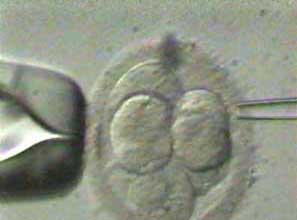 Fig 1. Assisted hatching. The embryo is held securely, and a carefully controlled stream is used to drill a hole in the zona (shell).
Other advanced options include:
- Embryo biopsy for genetic testing: Removing a single cell to check for genetic diseases (learn more here).
- Co-culture: Growing embryos on a bed of nurturing cells to improve their quality.
- Cytoplasmic transfer: Using cytoplasm from a healthy donor egg to support poor-quality eggs in rare cases.
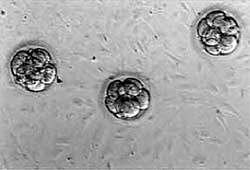 Fig 2. Embryo co-culture. Embryos are grown on a bed of cells which nurture the embryos.
These advances can help patients who have struggled with repeated IVF failures or unique challenges. But not every technique is needed for every patient. At Malpani Infertility Clinic, we recommend only what is truly necessary for your situation.
Making IVF More Manageable
It is easy to feel like IVF is becoming more complicated and expensive with every new technology. But sometimes, simpler can be just as effective, and much less stressful and costly.
Here are some methods that make IVF more accessible:
- Natural cycle IVF: Using your body’s own natural egg, with no heavy hormone stimulation. This reduces cost and side effects, though success rates per cycle are lower.
- Gentle ovarian stimulation: Using lower doses of hormones to minimize risks like ovarian hyperstimulation and reduce the number of visits and injections.
- Intravaginal culture: Placing eggs and sperm in a sealed vial inside the vagina so your body acts as its own incubator. This reduces the need for expensive lab equipment.
- Transport IVF: Eggs are retrieved locally and transported to a central lab for fertilization and embryo transfer, reducing travel and hospital stays.
At our clinic, we are committed to offering options that respect both your health and your budget, always backed by honest discussion of what is best for you.
Frequently Asked Questions
Q: What is the average IVF success rate?
A: For women under 35, IVF success rates per cycle are usually between 30% and 40%. Your own chances depend on age, diagnosis, embryo quality, and the clinic’s expertise.
Q: How does blastocyst transfer improve my chances?
A: Blastocyst transfer allows embryos to develop to Day 5 in the lab. This helps select the strongest embryos and may improve implantation rates, while reducing the risk of twins or triplets.
Q: Is embryo grading the only thing that matters for success?
A: No, embryo grading is a helpful guide but not a guarantee. Many other factors, like genetics and the uterine environment, play a big role.
Q: What is assisted hatching and when is it used?
A: Assisted hatching is a lab technique to help the embryo break out of its shell. It may be used for older women, those with previous IVF failures, or embryos with thick shells.
Q: How many IVF cycles should I plan for?
A: Most experts recommend being prepared for at least 3-4 cycles to give yourself the best cumulative chance. Each cycle is a new opportunity and does not decrease your odds.
Q: Are all clinics’ success rates trustworthy?
A: Not always. Some clinics use confusing definitions or select only easy cases. Ask to see the live birth rate per treatment cycle for the most honest comparison.
Q: What happens if none of my embryos reach the blastocyst stage?
A: While this is disappointing, it means those embryos likely would not have implanted. It saves you the emotional rollercoaster of a failed transfer and helps guide your next steps with your doctor.