

Donor Eggs and Donor Embryos
When you have tried everything in your power to build your family, yet each test, each cycle, seems to end with disappointment, you can start to feel invisible and alone. The world keeps moving, but your heart aches for a chance at parenthood that feels just out of reach. If you have been told you have no eggs, or no sperm, or if you have faced repeated failed IVF attempts, you might be wondering what doors, if any, are left open. You are not alone in these thoughts. Many couples are quietly asking: Could donor eggs or donor embryos be the answer for us?
Understanding Donor Eggs and Donor Embryos
It is a hard truth that sometimes, no matter how much you want it, your own eggs or sperm may not be able to help you start or grow your family. This is especially true for women with ovarian failure or men with complete testicular failure. The idea of using donor eggs, donor sperm, or donor embryos can feel overwhelming at first. There is a sense of loss, and sometimes even guilt or shame, that nobody talks about openly. Yet, for many, donor programs offer new hope where other treatments have failed.
For couples where the male partner has no sperm at all, donor sperm can be used in IVF. Advances like ICSI (a process where a single sperm is injected directly into an egg) mean donor sperm is now needed only for men with absolute, complete absence of sperm production.
Women who have no eggs due to ovarian failure, or who have a genetic condition that they do not want to pass on, may consider donor eggs. In this process, a healthy donor’s eggs are fertilized with the husband’s sperm, and the resulting embryo is placed in the woman’s uterus. This can also be an option for women with unexplained, long-standing infertility or those who have had several failed IVF cycles. Sometimes, women in their forties or even fifties, whose own eggs are no longer viable, are able to get pregnant using donor eggs.
In rare situations, where both partners are infertile, both donor eggs and donor sperm can be used together. When both are used, this results in the creation of a donor embryo.
The Process: How Donor Egg IVF and Embryo Donation Work
Understanding the process can help ease some of the anxiety and confusion. Here is what usually happens:
- For Donor Egg IVF: The egg donor undergoes hormonal stimulation to produce several mature eggs. These eggs are retrieved and fertilized in the lab with the husband’s sperm.
- The resulting embryo is then transferred into the recipient’s uterus, after her endometrial lining is made receptive using hormones (estrogen and progesterone).
- Today, thanks to egg freezing (vitrification), we can match donors and recipients more efficiently, synchronize cycles, and guarantee a good number of mature eggs for each cycle by using our egg bank at Malpani Infertility Clinic.
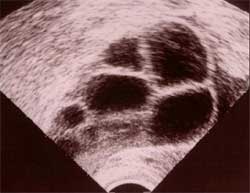 Fig 1. Ultrasound scan of the egg donor after superovulation. She has grown many follicles and is ready for egg retrieval
The donation process is not without its challenges. Egg donors must undergo hormone injections and an egg retrieval procedure, and while it is safe, it is more involved than sperm donation, which is painless and non-invasive.
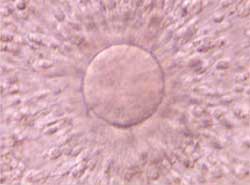 Fig 2. Mature oocyte cumulus complex
For the recipient woman: If she is not having periods (amenorrheic), her uterus is prepared using estrogen and progesterone so that it is ready to accept the embryo. Women who still have periods may need to have their natural cycle suppressed before hormones are started. Some women can have a transfer in their natural cycle as well. The goal is always to make sure the uterus is perfectly timed to allow the embryo to implant and grow.
- For Donor Embryo Treatment: Some couples require both donor sperm and donor eggs. In these cases, donor embryos are created and then transferred to the recipient’s uterus. There are also couples who, after their own successful IVF treatment, choose to donate their surplus frozen embryos to another couple. This is sometimes called embryo adoption. The treatment is very similar to adopting a baby, with the unique experience of carrying the pregnancy yourself.
Questions and Emotions Around Donor Eggs and Embryos
The decision to use donor eggs or embryos is rarely straightforward. It can feel like stepping into the unknown. Many couples worry: Will my body accept a donor embryo? Will I bond with this baby? What about the genetics?
All embryos are genetically foreign to the mother because half the DNA comes from the father, so donor embryos are not more likely to be rejected than any other embryo.
The uterus is actually an “immunologically privileged” space. This means it is naturally designed to accept and nurture an embryo, regardless of its genetic makeup. So, the chances of successful implantation with donor eggs or embryos are just as good as with your own embryos, if not better, especially when younger donor eggs are used.
There are also feelings of loss to work through: the loss of a genetic connection, the worries about disclosure, the questions about what the child will think one day. These are real, and at Malpani Infertility Clinic, we believe in discussing them honestly and openly. We encourage couples to take their time when making these choices. It is normal to have doubts and to revisit the decision as you process your emotions. Our team is here to guide you, not to push you, and to help you find the path that feels right for you.
The Benefits and Realities of Donor Egg and Embryo Programs
There are several reasons why donor programs can be life-changing for couples struggling with infertility:
- Higher Success Rates: Using eggs from young, healthy donors greatly improves the chance of pregnancy, even in women over 40.
- Experience of Pregnancy: Unlike adoption, you still experience pregnancy, birth, and breastfeeding, which can be important to many women.
- Cost-Effective Options: Sometimes, donor embryos are more readily available and more affordable than repeated failed IVF cycles or other fertility treatments.
- Emotional Closure: For couples who have embryos left over after their own IVF, donating them can be a way to honor the journey and help others.
At Malpani Infertility Clinic, we have streamlined protocols and advanced techniques such as vitrification, careful cycle synchronization, and personalized hormonal preparation to maximize your chance of success. We also ensure that there are enough mature donor eggs available for each treatment cycle, minimizing the uncertainty and stress for our patients.
What Nobody Tells You About Donor Eggs and Embryos
There is a lot of silence around donor eggs and embryos, as if choosing this path is something to keep hidden. The truth is, it takes immense courage to consider donation. It is normal to grieve the loss of your own genetic child, but it is also possible to find deep joy and connection with a child born through egg or embryo donation. You deserve to have honest information, not sugar-coated promises or empty reassurances.
Here is what we have seen, time and again, at Malpani Infertility Clinic:
- The bond you form with your baby is not defined by genes, but by love, care, and the experience you share from the moment you see that positive test.
- Your fears are valid and worth discussing openly. Do not let shame or secrecy rob you of your right to be a parent.
- There is no “one right way” to build your family. What matters is that you feel empowered to make the choice that fits your values and dreams.
of women under 40 using donor eggs can achieve a successful pregnancy, especially when protocols are tailored and advanced techniques are employed.
If you are unsure about how to proceed, or simply want advice from someone who has helped thousands of couples in similar situations, consider reaching out for a confidential chat with our experts.
Frequently Asked Questions
Q: Will my body reject a donor egg or embryo because it is not genetically mine?
A: No. The uterus is naturally designed to accept embryos, even if the genes are not yours. The success rates with donor eggs and embryos are very high, and the risk of rejection is not greater than with your own embryos.
Q: What is the process for using donor eggs in IVF?
A: The donor undergoes hormonal stimulation and egg retrieval. The eggs are fertilized with your partner’s sperm and the resulting embryo is placed in your uterus after preparing your uterine lining with hormones.
Q: Is using donor eggs or embryos emotionally difficult?
A: Many couples experience mixed feelings, including grief about genetics and hope for a child. These feelings are normal and worth discussing openly. Most parents find that the emotional connection with their child grows naturally.
Q: Can older women use donor eggs?
A: Yes. Many women in their forties and fifties have healthy pregnancies using donor eggs from younger women. Age of the uterus is far less important than egg quality.
Q: What is donor embryo or embryo adoption?
A: Donor embryos come from couples who have completed their family after IVF and choose to donate their remaining frozen embryos to others. You carry and deliver the baby yourself, much like standard IVF.
Q: What are the risks to egg donors?
A: Egg donors undergo hormonal stimulation and an egg retrieval procedure. While generally safe, there are some risks and discomfort involved, which are taken seriously and minimized as much as possible.
Q: How do I know if donor eggs or embryos are right for me?
A: If you have no eggs, poor egg quality, or a risk of passing on a genetic disease, donor eggs or embryos may be a good option. It is a personal decision, best made after detailed discussion with a fertility expert.