

How Babies are Made - The Basics (Page 2)
Have you ever caught yourself wondering why your body is not doing what you always thought it should? Maybe you have tracked your cycles for months, felt hope rise and fall, and quietly asked yourself: Is something wrong with me? If that sounds familiar, you are far from alone. Understanding how babies are made is not just biology from a textbook. It is an emotional, sometimes heartbreaking, journey for so many couples who long for a child. At Malpani Infertility Clinic, we believe that knowing the basics is the first step to taking control of your story. Let us walk you through what really happens inside the body, simply, clearly, and with the honesty you deserve.
Hormones: The Real Orchestrators of Fertility
Picture your body as an orchestra. Each instrument needs to be in tune, playing at the right moment, to create a beautiful harmony. In the world of reproduction, hormones act as the conductor. When something feels off, often it is because some part of this orchestra is out of sync.
Hormones are special messengers your body makes to send instructions from one place to another. For women, two main hormones, estrogen and progesterone, are produced by the ovaries. These are not just random chemicals. They are the signals that tell your body when to get ready for pregnancy, when to release an egg, and when to prepare the womb.
The monthly cycle has two main parts:
- Follicular Phase (First half): Estrogen takes the lead. During this time, an egg matures inside a small sac called a follicle. The follicle releases estrogen, which tells the lining of the uterus (the endometrium) to thicken, preparing a nest for a possible baby.
- Luteal Phase (Second half): After ovulation (when the egg is released), the follicle transforms into the corpus luteum. Now, it produces both estrogen and a large amount of progesterone. Progesterone tells the uterus lining to mature and get ready for the fertilized egg to implant. If there is no pregnancy, the levels of these hormones drop, and your body sheds the lining as your period.
All of this is managed by a feedback system, like the thermostat in your home. When estrogen levels rise, signals tell the brain’s pituitary gland to slow down hormone production, and vice versa. This keeps everything balanced, unless something disrupts the cycle.
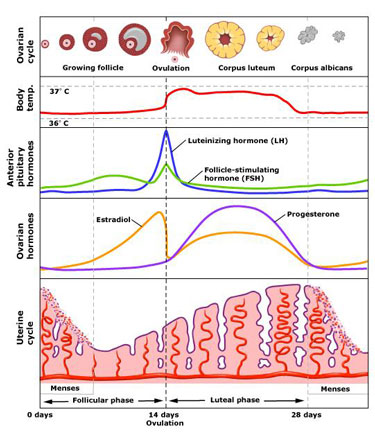
Fig 5. A schematic of the hormonal changes during the menstrual cycle. The interplay of the pituitary and ovarian hormones regulate the changes which occur in the uterine lining.
Fertility is not just about having eggs and sperm. It is about timing, balance, and the gentle dance of hormones every single month.
Inside the Male Reproductive System
For many couples, the focus is often on the woman, but the male partner is just as important. The male reproductive system might sound complicated, but it is all about making and delivering healthy sperm, tiny cells that carry half the genetic material needed to make a baby.
The journey starts in the testicles, found in the scrotum behind the penis. These organs have two jobs: making sperm and producing testosterone (the main male hormone). The testicles are designed to stay slightly cooler than the rest of your body, nature’s way of protecting sperm health.
Inside the testicles are tightly coiled tubes called seminiferous tubules. These are the assembly lines where sperm are made. It takes about 75 days for a sperm to fully develop. The process relies on a steady supply of hormones and a nurturing environment. Sperm travel from these tubules to a network of ducts, eventually reaching the epididymis, a long, coiled tube where sperm mature and are stored.
Here is something most people never hear: Sperm are not ready to swim or fertilize an egg when they first leave the testicles. They need to spend time in the epididymis, which acts like a finishing school, giving them the skills they need. Only then are they ready to travel up the vas deferens during ejaculation, mix with fluids from the seminal vesicles and prostate, and exit through the penis.
Why Understanding These Basics Matters
If you have struggled with infertility, you might have felt lost or even blamed yourself. The truth is that the process of making a baby is far more delicate than most people realize. There are so many steps where things can quietly go wrong, often without any obvious symptoms. Sometimes, it is a hormonal signal that is off by a fraction. Sometimes, the sperm did not finish “school” in the epididymis. Sometimes, the womb is not quite ready to welcome a fertilized egg.
Knowing the basics is not about memorizing anatomy. It is about understanding that infertility is rarely anyone’s fault. It is about recognizing when your body needs a bit of help, and knowing what questions to ask your doctor. At Malpani Infertility Clinic, we see every patient as a unique individual, not just a set of test results. We believe in honest conversations, clear explanations, and empowering you to make informed choices.
What Happens When Something Goes Wrong?
If either partner’s reproductive system is out of sync, even slightly, conception can become a challenge. Some common disruptions include:
- Irregular periods: May signal a problem with hormone levels or ovulation.
- Low sperm count or motility: Sperm may not be produced in enough numbers or may struggle to reach the egg.
- Blocked tubes: In men or women, blockages can prevent eggs and sperm from meeting.
- Unexplained infertility: Sometimes, all tests come back normal, but pregnancy still does not happen. This can be especially frustrating and isolating.
The good news? Most causes of infertility can be addressed with the right guidance. Simple blood tests, semen analysis, and ultrasound scans can provide crucial information. If you are overwhelmed by medical jargon or need a second opinion, you deserve answers that make sense, without judgement or false promises.
You Are Not Alone, Real Help Is Available
Infertility can make you feel invisible and misunderstood, especially when everyone else seems to get pregnant so easily. But there is real hope, and you do not have to face this journey alone. At Malpani Infertility Clinic, our doctors take the time to explain, demystify, and guide, not just prescribe. We want you to feel heard, supported, and empowered to take the next step, whether that is understanding your test results or deciding on a treatment plan. Sometimes, all it takes is one honest conversation to change your perspective and give you back hope.
Frequently Asked Questions
Q: What role do hormones play in fertility?
A: Hormones such as estrogen and progesterone coordinate the timing of ovulation and prepare the uterus for pregnancy. In men, testosterone is essential for sperm production. Any imbalance can affect fertility in subtle or obvious ways.
Q: How long does it take for sperm to mature?
A: It takes about 75 days for sperm to develop and mature in the testes and epididymis before they are ready to fertilize an egg.
Q: Can stress or illness affect fertility?
A: Yes, both emotional and physical stress can disrupt hormone balance and sperm production, making it harder to conceive.
Q: What tests are usually done to check fertility?
A: Common tests include hormone blood tests, semen analysis, and ultrasound scans of the reproductive organs. Your doctor may suggest additional tests based on your medical history.
Q: When should I consider seeing a fertility specialist?
A: If you have been trying to conceive for over a year (or six months if you are over 35), or if you have irregular periods, known reproductive issues, or a history of miscarriages, it is a good idea to seek professional advice.