
The Mosaic Embryo Trap: Why You Need Counselling Before You Pay for PGD/PGT/PGS
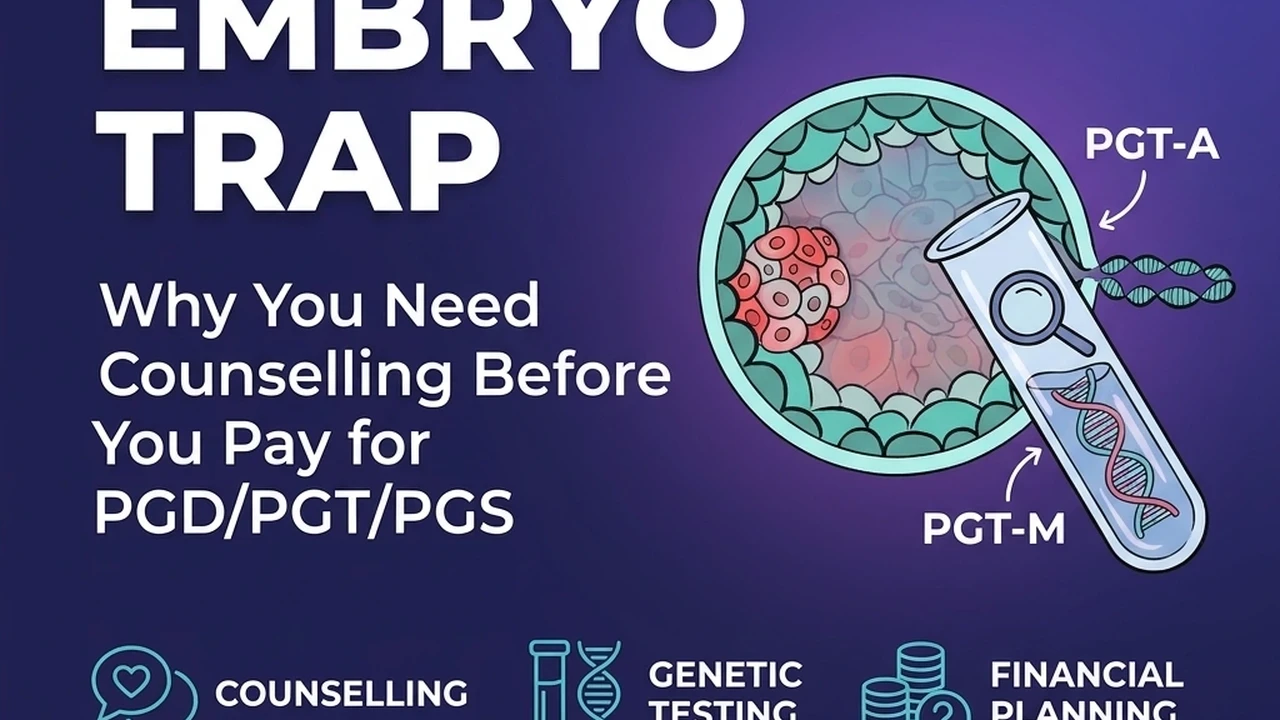
You sit across from your doctor, clutching the envelope with your embryo genetic testing results. The words look like a foreign language, but one term jumps out and fills you with dread: mosaic embryo. Your stomach drops. You thought testing your embryos would make things simple, that it would help you pick the best one and avoid heartbreak. But now, instead of answers, you feel more lost than ever. If this is you, you are not alone—hundreds of couples at Malpani Infertility Clinic have walked this same confusing and emotional path.
What Is PGT, and Why Do So Many IVF Patients Choose It?
When you start IVF, your clinic may suggest preimplantation genetic testing (PGT). The promise sounds straightforward: test your embryos, find the ones with the right number of chromosomes (euploid), and increase your chances of a healthy pregnancy. But behind the acronyms—PGD, PGS, PGT, and PGT-A—there is a lot of misunderstanding. Let’s break it down:
- PGD: Preimplantation Genetic Diagnosis (older term)
- PGS: Preimplantation Genetic Screening (older term)
- PGT: Preimplantation Genetic Testing (current term)
- PGT-A: Testing for abnormal chromosome numbers (aneuploidy)
Whatever the name, the process is the same. Once your embryos have grown to the blastocyst (day 5 or 6) stage, a few cells are gently removed from the outer layer (the part that becomes the placenta). These cells are sent to a genetics lab for analysis, while your embryos are frozen. About ten days later, you get the results.
It all sounds like a no-brainer, but what nobody tells you is that this genetic snapshot comes with its own set of tough decisions—and anxiety you never expected.
Mosaic Embryos: The Result No One Warns You About
The shock comes when your report says “mosaic embryo.” What does that even mean?
A mosaic embryo is one where some cells have the normal number of chromosomes and others do not. The test only looks at a handful of cells from the outer layer (future placenta), not the part that becomes the baby. So, the result is a bit like judging a 1,000-page novel by reading one paragraph—and if you find a typo in that paragraph, you might be tempted to throw the whole book away.
Many healthy children have been born from embryos labeled as “mosaic.” If every mosaic embryo was discarded, thousands of families would never have existed.
The truth is, embryos can “self-correct.” Abnormal cells may be pushed aside or lost as the embryo develops, leaving only the normal cells to grow into a healthy baby. But the test cannot tell you if this will happen with your embryo. And that is where the emotional turmoil begins.
The Real-World Impact: Confusion, Conflict, and Hard Choices
What do you do when your only embryo is mosaic? Some doctors say discard it. Others say transfer it—many healthy babies have resulted from mosaic embryos. A third group says, “It’s your decision.” Suddenly, you are left with a choice you never expected to face, and the stakes could not be higher. This is not what you signed up for—you just wanted a baby, not a moral dilemma.
Worse, most IVF specialists are not geneticists. They may sound confident, but few have deep training in interpreting mosaicism. You are left to make a life-defining decision while feeling completely out of your depth, and sometimes with conflicting advice from different experts.
What Does the Science Say About Mosaic Embryos?
Mosaic embryos are not rare. Depending on the lab and technology, between 5% and 30% of embryos may be labeled as mosaic. The incidence can be higher in couples with male factor infertility or those who produce many eggs.
But here is the hopeful news: multiple studies now show that many mosaic embryos—especially those with a lower percentage of abnormal cells—can implant, develop normally, and result in healthy live births. In fact, some clinics have reported
live birth rates from low-level mosaic embryo transfers
The risk does depend on factors like:
- Level of mosaicism: Embryos with a low proportion of abnormal cells (<50%) have better outcomes than high-level mosaics.
- Which chromosomes are involved: Some chromosomal errors are more likely to self-correct or have less impact if carried to term.
- Type of abnormality: Segmental (small piece) errors may be less concerning than whole-chromosome errors.
But here is the hard truth: No test can tell you for sure what will happen with your specific embryo. The only way to know if an embryo can make a healthy baby is to actually transfer it and see if it implants and develops normally.
Before You Pay for PGT: Why Counselling Matters
It is tempting to see PGT as a simple upgrade to IVF, but the reality is more complicated. The technology is powerful but imperfect. It can spare you from heartbreak, but it can also drop a new burden in your lap: what to do with a mosaic embryo.
That is why, at Malpani Infertility Clinic, we believe in talking you through every possibility, before you spend a single rupee. You deserve to know:
- What PGT can and cannot tell you
- How often mosaic results happen
- What your options will be if you get a mosaic result
- How to weigh the risks and benefits for your family, not just statistics
We have seen too many patients spend extra money, go through extra procedures, only to be blindsided and distressed by a result that no one prepared them for. A good clinic will help you think through your plan before you get your results, so you can make decisions calmly and confidently—not in a panic after the fact.
Mosaic embryos are not a dead end. With the right information and support, you can make the best choice for your unique situation.
Making the Decision: What Should You Ask?
Before you decide to do PGT/PGT-A, ask your doctor:
- If my embryo comes back mosaic, what guidance will you give me?
- How experienced is your team in interpreting mosaic results?
- What does the research say about outcomes for mosaic embryos?
- Will you help me decide what to do if I get a mosaic result, or will the decision be left to me alone?
If you get honest, straightforward answers, you are in capable hands. If you get vague reassurances or see your questions brushed aside, consider whether you want to trust your future family to that clinic.
At Malpani Infertility Clinic, our commitment is to full transparency and honest guidance, even when it is uncomfortable. We want you to feel empowered and supported, whether you choose to transfer a mosaic embryo, discard it, or try another cycle. Learn more about PGD/PGT here.
Frequently Asked Questions
Q: What is a mosaic embryo?
A: A mosaic embryo is one where some cells have the normal number of chromosomes, while others do not. This happens when errors occur after fertilization, leading to a mix of normal and abnormal cells within the same embryo.
Q: Can a mosaic embryo become a healthy baby?
A: Yes, many mosaic embryos can result in healthy live births. Studies show that especially when the level of abnormal cells is low, the chances are good, though not guaranteed.
Q: Should I transfer a mosaic embryo if it is my only option?
A: This is a deeply personal decision. Many couples do choose to transfer mosaic embryos and have healthy children, but there are risks. You should discuss your unique situation in detail with your fertility doctor.
Q: How common are mosaic embryos after PGT?
A: Depending on your age, fertility factors, and the technology used, 5% to 30% of tested embryos may be labeled as mosaic.
Q: Why do different doctors give different advice about mosaic embryos?
A: Mosaicism is a complex area. Not all IVF doctors are genetics experts, and research is still evolving. That is why it is important to work with a clinic that is transparent and up to date with the latest studies.
Q: What should I do before I pay for PGT?
A: Insist on a detailed counselling session about all possible results—including mosaicism—and the plan if you receive such a result. This discussion should happen before you pay or start the test.
Q: Where can I get more support or advice?
A: You can speak to an expert fertility advisor at Malpani Infertility Clinic for guidance tailored to your personal situation.