
Do You Need Surgical Sperm Retrieval?
Imagine sitting in the doctor's office, hearing that your semen analysis came back with zero sperm. Your mind races. You wonder if there is any hope of being a biological father. You feel isolated, overwhelmed, and maybe even a bit ashamed. If you or your partner just received a diagnosis of azoospermia—where there is no sperm in the ejaculate—know that you are not alone, and that there is still a realistic path to parenthood, thanks to advances in surgical sperm retrieval.
Why Surgical Sperm Retrieval May Be Needed
For many men, a diagnosis of azoospermia comes as a shock. About 10 to 15 percent of men struggling with infertility face this condition. The causes are not always the same. Sometimes there is a blockage in the tubes that carry sperm, or a condition since birth (like absence of the vas deferens). Other times, the testicles themselves are not making enough sperm. Regardless of the reason, when sperm are not found in the ejaculate, specialized techniques can retrieve sperm directly from where they are being produced or stored inside the body.
Many couples who once felt hopeless after hearing “no sperm found” have gone on to have their own biological children with the right technique and guidance.
To understand if surgical sperm retrieval is right for you, it helps to know the two main types of azoospermia:
- Obstructive azoospermia: Sperm are produced normally but cannot reach the semen due to a blockage.
- Non-obstructive azoospermia: The testicles are not producing enough sperm, or sperm production is patchy.
Curious to read more? See our detailed guide: Zero sperm count Diagnosis and Treatment
How Are Sperm Retrieved? The Main Techniques Explained
At Malpani Infertility Clinic, we are dedicated to using the least invasive, most effective methods to help our patients. Over the years, several techniques have been developed. Each one suits a different situation, and the right choice can make all the difference for your comfort, safety, and chance of success.
PESA: The Simpler, Kinder Approach to Sperm Retrieval
The first techniques for sperm retrieval involved complex surgery and cutting-edge microscopes. Dr. Sherman Silber pioneered microsurgical epididymal sperm aspiration (MESA), which required opening the scrotum and working under a microscope to collect sperm from the epididymis. While effective, it was complicated, costly, and left behind surgical scars.
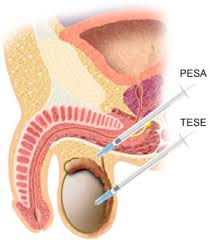
Realizing that patients deserved something easier, Dr. Pankaj Srivastav developed a breakthrough: PESA (Percutaneous Epididymal Sperm Aspiration). Instead of surgery, a fine needle is used to gently draw sperm directly from the epididymis through the skin, much like drawing blood.
- No cuts, no stitches, and no visible scars
- Fast and almost painless—done under local anesthesia
- As effective as traditional microsurgery for retrieving sperm in men with obstructive azoospermia
- More affordable, as it does not require an operating microscope or a surgical team
- Can be performed by a skilled infertility specialist without needing a urologist
TESA: Retrieving Sperm When the Epididymis Is Not an Option
Sometimes, PESA is not possible or does not yield sperm—especially if the blockage is higher up, or in cases where sperm production is the issue. In these situations, the next step is TESA (Testicular Sperm Aspiration).
TESA involves using a fine needle to gently remove a small piece of tissue from the testicle, again under local anesthesia. This tissue is then carefully processed in the laboratory to extract any sperm present. There is no large incision, no stitches, and the procedure is relatively quick and well-tolerated. It is often possible to find sperm even in men who were told their testicles are too small or not producing sperm, because sperm production can be patchy—healthy areas may still exist, even if the rest of the testicle is not functioning well.
The sperm recovered by PESA or TESA are then used for ICSI (Intracytoplasmic Sperm Injection), where a single sperm is injected directly into an egg to fertilize it. This technique has helped thousands of couples with severe male factor infertility become parents.
“Blind” Versus Microsurgical Retrieval: What Really Matters?
In recent years, some clinics have promoted advanced microsurgical techniques—using high-powered microscopes to identify “healthy-looking” tissue in the hope of increasing sperm retrieval rates. While these procedures sound high-tech, the reality is that simpler “blind” approaches—where many small samples are taken from different parts of the testicle—are just as effective, less traumatic, and much less costly.
At Malpani Infertility Clinic, we use a multiple “micro-biopsy” needle technique. By sampling different areas, even in men with very small or poorly functioning testicles, we maximize the chance of finding viable sperm. This approach avoids damage to blood vessels, causes minimal pain, and preserves testicular function for the future. If needed, the procedure can be safely repeated after a few months. Our focus is always on what truly benefits the patient, not what sounds fancy or allows us to charge more. We want to empower you with honest, no-nonsense advice and options.
What About the Cost?
Fertility treatments can be expensive, and we believe that every couple deserves an affordable path to parenthood. In some countries, surgical sperm retrieval can cost between $3000 and $5000 per attempt, especially if a urologist and operating room are involved. At Malpani Infertility Clinic, both PESA and TESA are performed for just $500 each. By focusing on what works best—with the least pain and lowest cost—we make advanced fertility care accessible to more couples who need it.
The goal is always to get enough healthy sperm for ICSI while keeping the process simple, safe, and affordable for you.
For more hope and real-life inspiration, read: An IVF success story for a man with azoospermia
What Should You Do Next?
Learning you have azoospermia is hard, but it is not the end of the road. The right diagnostic tests, honest guidance, and a clinic that truly cares can make all the difference. At Malpani Infertility Clinic, Dr. Malpani and his team are always ready to help you understand your options, answer your questions, and help you make the best choices for your family. If you are unsure about your diagnosis, the right technique, or simply want to talk to someone who will give you straightforward advice, reach out today. Getting proper guidance early can save you time, money, and heartache.
Frequently Asked Questions
Q: Will surgical sperm retrieval hurt?
A: Most procedures like PESA and TESA are done under local anesthesia. You may feel some discomfort but not pain. Recovery is quick and most men return to normal activities within a day or two.
Q: Can sperm always be found with these techniques?
A: In men with obstructive azoospermia (blockage), sperm can be found in nearly all cases. For men with non-obstructive azoospermia (poor or patchy production), sperm can be found in about 30 to 50 percent of cases, depending on the underlying cause and the technique used.
Q: Are these procedures safe for future fertility or testosterone levels?
A: When done properly using fine needle techniques, there is minimal damage to the testicles. There is a very low risk of affecting testosterone levels or long-term fertility.
Q: How is the sperm used after retrieval?
A: The sperm is either used immediately for ICSI (intracytoplasmic sperm injection) with IVF, or frozen for future use. Even a few sperm are enough for ICSI.
Q: Is it better to use a high-tech, expensive microsurgical method?
A: For most men, simpler needle techniques are just as effective and much less invasive. The more expensive procedures are rarely necessary except in very rare, complex cases.
Q: What if sperm is not found the first time?
A: The procedure can be repeated after a few months. Sometimes, taking samples from different areas or at a different time increases the chance of finding sperm.