
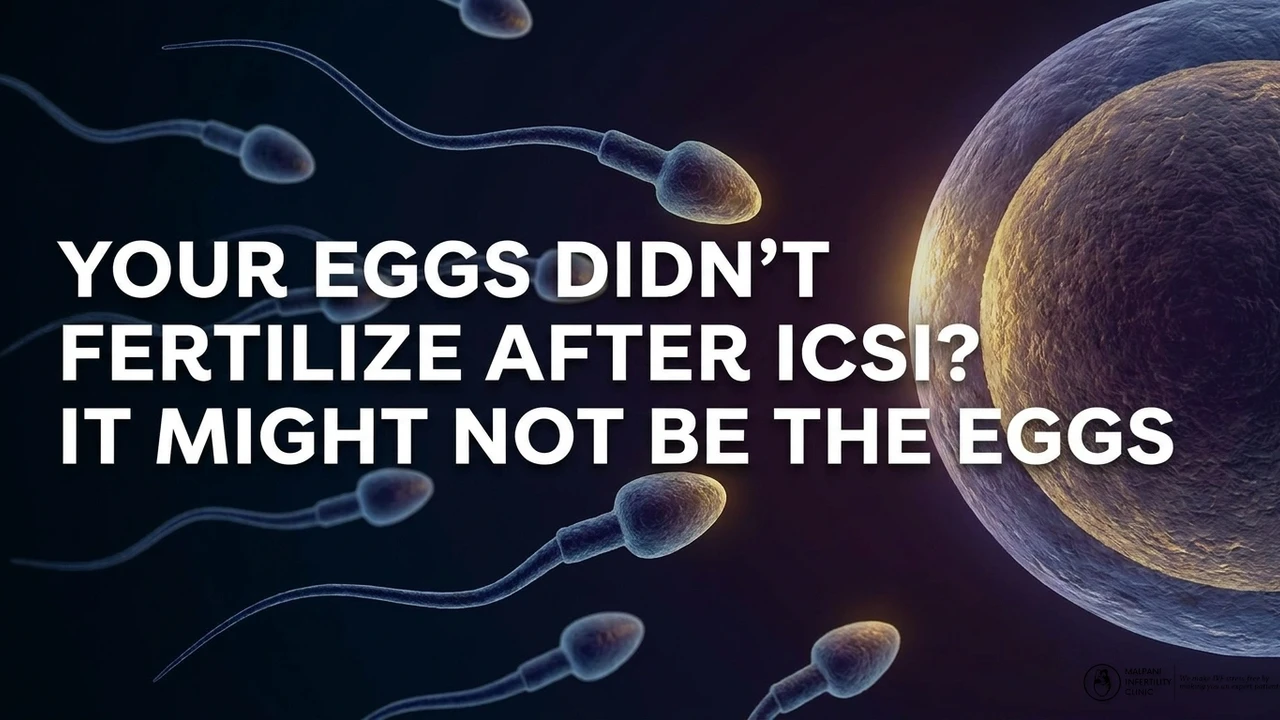
Your eggs didn't fertilize after ICSI? It might not be the eggs
You wake up the morning after your egg retrieval, heart pounding, desperate for the call that will finally bring some good news. But instead, you hear the words no one prepares you for: none of your eggs fertilized, even after ICSI. It feels like the ground falls away beneath you. All those injections, the anxiety, the money, the hope – and now you are left with nothing but questions and a crushing sense of loss. If you are reading this, you are not alone. Many couples have been through this heartbreak, and at Malpani Infertility Clinic, we believe you deserve real answers and a fair chance at hope.
When Fertilization Fails After ICSI
In most IVF cycles, if the sperm cannot fertilize the egg on its own, we use ICSI: a skilled embryologist selects a single sperm and injects it directly into the egg. This should overcome most issues related to sperm movement or binding. So, when fertilization still fails completely after ICSI, it can leave everyone stunned – and searching for explanations.
The conversation that follows often feels scripted. You might be told, “the eggs were poor quality,” and that is the end of the discussion. But this answer is incomplete. In reality, there are several reasons why fertilization can fail after ICSI, and blaming the eggs is often the easiest – but not always the right – conclusion.
What Really Causes Failed Fertilization?
Let us break down the three main areas that should be investigated when ICSI does not work – and why it matters so much to get a proper answer.
- The Embryologist’s Skill: ICSI is not a button you push; it is a delicate, hands-on procedure. An experienced embryologist holds a microscopic glass needle, selects a sperm, and gently injects it through the egg’s protective shell and inner membrane. If this process is rushed or done without precision, the egg can be damaged. Damaged eggs will not fertilize, but too often, the eggs (and by extension, the patient) are blamed for this. At Malpani Infertility Clinic, we encourage you to ask about the lab’s protocols and the embryologist’s experience. This is not a comfortable question for many clinics, but it is your right to know who is handling your future.
- The Egg’s Internal Machinery: Sometimes, eggs retrieved in women with lower ovarian reserve simply do not have the right internal “machinery” to complete fertilization, even if the sperm is placed perfectly inside. This is more common as women age or if the number of eggs is low. But this is not the first thing you should assume. It is a diagnosis of exclusion – something you consider only after exploring all other possibilities.
- Hidden Sperm Problems: Globozoospermia
There is a rare but crucial sperm problem that is often overlooked: globozoospermia. In this condition, the sperm have round heads and lack the acrosome – the “cap” that acts like the striking tip of a match, sparking the fertilization process inside the egg.
A missing acrosome means the sperm cannot deliver the chemical “spark” that switches the egg on, even if injected directly inside.
Standard semen analysis might report “normal” numbers, missing this detail entirely. The sperm might look ordinary on paper, but without special staining and microscopic examination focused on the acrosome, globozoospermia goes undetected. The result? Fertilization fails, and the eggs get blamed unfairly.
How Can Fertilization Failure Be Fixed?
If globozoospermia is discovered, there is a solution called assisted oocyte activation (AOA). This technique uses a special chemical (called a calcium ionophore) to mimic the natural signal that should have come from the sperm. The egg receives the “switch-on” message and, in many cases, fertilizes normally.
In other words, the same eggs and the same sperm can turn into healthy embryos – if the missing signal is supplied. This is why it is so important not to give up after one failed cycle, or to accept the first explanation you hear.
of mature eggs should fertilize with ICSI on average, but even in top labs, complete fertilization failure can occur in a small fraction of cycles.
When fertilization fails, some clinics might quickly suggest switching to donor eggs, which is a huge emotional and financial decision. But if the real issue is a hidden sperm problem, there is no need to abandon hope for a genetic child. This is why Malpani Infertility Clinic insists on a thorough evaluation, including:
- Review of the lab’s technique and the embryologist’s training
- Detailed sperm morphology study with special staining for acrosomes
- Requesting photos of the unfertilized eggs for expert review
This methodical approach ensures that treatable causes are not missed and that patients are not guided toward unnecessary or premature choices.
The Emotional Toll and What You Can Do
No one talks enough about the pain of a failed ICSI cycle. There is grief, anger, and a sense of shame that you “failed” at something so deeply personal. Many couples blame themselves, or each other, or even lose hope that they will ever have a child of their own.
You deserve better than a quick answer and a closed door. At Malpani Infertility Clinic, we believe in giving you the full picture: the science, the options, and the compassion you need to make informed choices. Our team is always willing to review your reports, discuss your case in detail, and help you understand if there are other avenues worth exploring before making big decisions about donor eggs or more aggressive treatments.
Questions you can ask your clinic:
- Was the sperm morphology examined with special staining for acrosome presence?
- Can we see photos of the unfertilized eggs?
- How experienced is the embryologist performing ICSI in your lab?
- Are there protocols in place for rare conditions like globozoospermia and AOA?
Moving Forward With Confidence
A failed ICSI cycle does not mean your story ends here. Sometimes, all it takes is asking the right questions, insisting on the right tests, and finding a team who respects your need for honest answers. Whether your next step is a new treatment protocol, assisted oocyte activation, or simply a second opinion, you have the right to hope – and to clarity.
If you are unsure about your next steps or have lingering doubts about your diagnosis, you can always reach out to speak to an expert fertility advisor at Malpani Infertility Clinic. Sometimes, a single conversation can open up options you did not know existed.
Frequently Asked Questions
Q: What should I do if none of my eggs fertilized after ICSI?
A: Ask your clinic for a detailed review. Insist on a strict sperm morphology study with special staining for acrosome presence, review the embryologist’s technique, and request images of the unfertilized eggs. There may be treatable causes that have not been considered yet.
Q: Is poor egg quality always the reason for failed fertilization after ICSI?
A: No, poor egg quality is sometimes blamed by default but is not always the real cause. Lab technique and hidden sperm defects like globozoospermia are often overlooked and can be fixed or managed with the right approach.
Q: What is globozoospermia and how is it diagnosed?
A: Globozoospermia is a rare sperm defect where the sperm lacks its “cap” (acrosome) and cannot trigger fertilization, even with ICSI. Diagnosis requires special staining and a detailed morphology study to look specifically for the acrosome.
Q: Can assisted oocyte activation (AOA) help if fertilization fails?
A: Yes, AOA can mimic the natural fertilization signal in eggs where the sperm cannot provide it, such as in globozoospermia. This can sometimes help the same eggs and sperm produce embryos after a failed cycle.
Q: Should I consider donor eggs after a failed ICSI cycle?
A: Not immediately. Make sure all possible causes have been properly investigated before moving to donor eggs. A second opinion and thorough evaluation can help you make the best decision for your situation.