
Fallopian Tube Testing | Diagnosis and treatment of Tubal disease (HSG and Sonosalpingogram)
What are the fallopian tubes?
How do tubal diseases cause infertility?
How is the tubal disease diagnosed?
What are the limitations of diagnosing tubal disease?
What are the recent innovations for tubal factor diagnosis and treatment?
What are the fallopian tubes?
The fallopian tubes project out from each side of the body of the uterus and form the passages through which the egg is conducted from the ovary into the uterus. The fallopian tubes are about 10 cms long and the outer end of each tube is funnel-shaped, ending in long fringes called fimbriae. The fimbriae catch the mature egg and channel it down into the fallopian tube when released by the ovary.
The tube itself is a muscular highly movable structure capable of highly coordinated movement. The egg and sperm meet in the outer half of the fallopian tube, called the ampulla. Fertilization occurs here, after which the embryo continues down the tube toward the uterus. The uterine end of the tube, called the isthmus, acts as a sphincter and prevents the embryo from being released into the uterus until just the right time for implantation, which is about 4 to 7 days after ovulation.
The tube is much more complex than a simple pipe, and the lining of the tube is folded and lined with microscopic hair-like projections called cilia which push the egg and embryo along the tube. The tubal lining also produces a fluid that nourishes the egg and embryo during their journey in the tube.
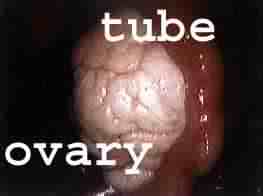
Fig 1. Normal tube and ovary, as seen during laparoscopy
How do tubal diseases cause infertility?
Tubal disease
Tubal abnormalities account for between 25% and 50% of female infertility. Tubal damage usually occurs through pelvic infection, and this is called pelvic inflammatory disease ( PID). Often, we cannot find out the cause of the inflammation. However, some of the causes of pelvic infection that can be pinpointed are :
- Sexually transmitted diseases (e.g. Gonorrhea, Chlamydia)
- Infection after childbirth, miscarriage, termination of pregnancy ( MTP) or IUD (intrauterine device) insertion
- Post-operative pelvic infection (e.g. perforated appendix, ovarian cysts)
- Severe endometriosis
- Tuberculosis
Besides causing blocked tubes, and pelvic inflammatory disease can also produce bands of scar tissue called adhesions, which can alter the functioning of the fallopian tubes. PID can be a silent disease, and most women with tubal damage because of PID are completely unaware that they have this disease.
Pelvic tuberculosis is a rare cause of tubal damage in India. The tuberculosis bacteria reach the tubes from the lungs through the bloodstream and can cause irreparable tubal damage. The problem is that genital TB is overdiagnosed and misdiagnosed. The commonest test to make this diagnosis is the TB PCR, but these are very unreliable! You can read more about this at http://blog.drmalpani.com/2015/03/laboratory-tb-versus-genital-tb.html. Please do NOT waste your time and money or risk your health by taking unnecessary toxic anti TB drugs
How is the tubal disease diagnosed?
Making a Diagnosis of Tubal disease
A number of tests are available to judge whether or not the tubes are open.
The simplest and oldest test for tubal patency is the RT or Rubin's test named after its inventor. In this test, gas is passed under pressure into the tubes through the cervix and uterus - either with a special machine (Rubin's apparatus) or with an ordinary syringe. The doctor then listens with a stethoscope placed on the abdomen to determine if he can hear the sound of gas passing through the fallopian tube. Even though this test is now obsolete, because it is so unreliable, a number of doctors still do it.
Blood tests for chlamydial antibodies: Since infection with chlamydia is the commonest reason for tubal disease in the West, some doctors test the blood for antibodies against chlamydia. Women who have antibodies against chlamydia have been exposed to this infection in the past, and are considered to be at higher risk for tubal damage.
Hysterosalpingogram (Uterotubogram) or HSG is a specialized X-ray of the uterus and tubes. An HSG is done after the menstrual flow has just stopped - usually on Day 6 or 7 of the period, at which time the lining of the uterus is thin. It is done in an X-ray Clinic. The patient is advised to take an antibiotic and a pain-killer before the procedure by many doctors. After being positioned on the X-ray table, the doctor places a special instrument into the cervix, called a cervical cannula, which is made of metal. Many doctors now prefer to use a balloon catheter, as this makes the procedure less painful. A radio-opaque dye (a liquid which is opaque to X-rays) is then injected into the uterine cavity. This is done slowly under pressure, and pictures are taken - preferably under an image intensifier. The passage of the dye into the uterine cavity and then into the tubes and from there into the abdomen can be seen; and X-ray pictures were taken. These provide a permanent record.
At least 3 films need to be taken to provide a reliable record - including an early film for the uterine cavity, and a delayed film to make sure the spill in the abdomen is free.
A normal HSG defines the inside of the reproductive tract. This appears as a triangle (usually white on a black background) which represents the uterine cavity; and from here the dye enters the tubes which appear as two long thin lines, one on either side of the cavity. When the dye spills into the abdomen from a patent ( open) tube, this appears as a smudge in the X-rays.
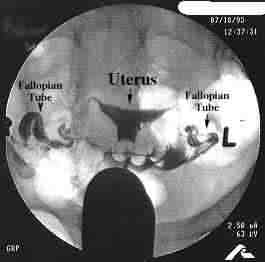
Fig 2. Normal HSG findings ( the dye appears black and outlines a normal cavity and fallopian tubes)
An abnormal HSG may show a problem in the uterine cavity - and this appears as a gap or filling defect. However, the commonest problems on HSG appear in the tubes. If the tubes are blocked at the cornual end (at the uterotubal junction), then no dye enters the tubes and they cannot be seen at all. If the block is at the fimbrial end then the tubes fill up, but the dye does not spill out into the abdominal cavity and the end of the tubes are often swollen up.
Sometimes, like any other medical test, the HSG may provide erroneous results. For example, the cornu of the uterus may go into spasm, as a result of which the dye may not enter the tubes at all. This may be interpreted as a tubal block, whereas in reality, the tubes are open. Also, if a hydrosalpinx is very thin and if the dye is injected under pressure, the dye may appear to spill into the abdomen through a tear in the wall of the hydrosalpinx - suggesting tubal patency when really the tubes are closed.
While the HSG is usually very reliable for determining whether or not the tubes are open, it provides little information on structures outside the tube which could nevertheless impair tubal function - such as peritubular adhesions. If the spill is "loculated",(i.e. it collects in small puddles), the presence of adhesions can be suspected, but not confirmed.
An HSG can be painful - and when the dye is injected into the uterine cavity, most women will experience a considerable amount of pain. You should be prepared for this - and taking a pain-killer prior to the procedure will help to reduce the pain.
An HSG can be technically difficult for some women (especially if the cervix is too small or too tight) - and it is better if a gynecologist is present at the time of the HSG to assist the radiologist if needed. Many gynecologists will do the HSG themselves.
The major risk of an HSG is that of spreading an unrecognized infection from the cervix up into the tubes. This is uncommon, but in order to reduce the risk, many doctors advise antibiotic coverage during the procedure.
If the HSG shows that the tubes are closed, then it may be advisable to repeat the HSG; and also to do a laparoscopy to confirm this diagnosis.
Laparoscopy. This has already been described and is the gold standard for making a diagnosis of tubal disease.
What are the limitations of diagnosing tubal disease?
Limitations of HSG and laparoscopy
The trouble with both HSG and laparoscopy is that they only provide information as to whether or not the tube is open or closed. While a closed tube will never work, they do not provide any information on how well an apparently open tube works. Remember, that just because a tube is a patent does not necessarily mean that it works!
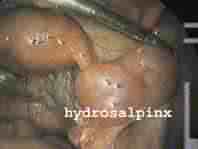
Fig 3. Laparoscopy shows a large hydrosalpinx on the right side
Another limitation is that they will rarely provide any information as to why the tubes are blocked. Occasionally, however, this can be suspected by other signs (for example, by seeing the tubercles diagnostic of TB in the abdomen during laparoscopy).
What are the recent innovations for tubal factor diagnosis and treatment?
Recent innovations in this field include:
Fluoroscopic guided procedures:
Using an image intensifier, and techniques borrowed from coronary angioplasty, the radiologists can now insert special catheters under fluoroscopic guidance into each of the tubes. This is called selective salpingography and allows much better visualization of each tube. It also allows the radiologist to treat corneal blocks which are due to mucus plugs by tubal cannulation, using a technique called FTR, or fallopian tubal recanalization. Read more at http://www.drmalpani.com/knowledge-center/articles/ftr-fallopian-tubal-recanalisation
Sonosalpingography:
Under ultrasound guidance, with Doppler facilities, if available, the gynecologist can inject fluid into the tubes through the cervix and see the flow of the fluid into the tubes and abdomen on the ultrasound screen. This is a simple bedside test which a gynecologist can do to judge if the tubes are normal - and can be reassuring if positive.
Tuboscopy:
At the time of laparoscopy, the doctor can insert a fine telescope into the fallopian tube through its fimbrial end, to inspect the inner lining of the tube, to judge whether or not it is healthy.
Falloposcopy is a recent advance, pioneered by Dr. Kerin of the USA. In this method, a very fine flexible fiberoptic tube is guided through the cervix and uterus into each fallopian tube, thus allowing the doctor to actually visualize the inner lining of the entire length of the fallopian tube - something which was never possible so far. This can provide useful information about the extent of tubal damage, and the possibility for a successful repair.