
Risks and complications of IVF
What are the risks and complications of IVF ?
What is OHSS ( ovarian hyperstimulation syndrome) ?
What about the risk of a multiple pregnancy after IVF ?
What about the dangers of overtreatment and undertreatment ?
How can you support each other during your IVF cycle ?
How can you select the best IVF clinic for yourself ?
What questions should you ask when selecting an IVF
clinic ?

What are the risks and complications of IVF ?
Risks and Complications of IVF
Many couples are still worried that babies born after IVF are abnormal or weak. You need to remember that in one sense there is nothing "artificial" about these babies - they aren't synthetic babies which are being manufactured in the laboratory ! Remember that IVF is a form of assisted reproductive technology, where technology is being used to assist Nature to accomplish what it has failed to do for the infertile couple ! Over a hundred thousand babies have now been born after IVF treatment, and the risk for birth defects is not increased after IVF treatment.
What is OHSS ( ovarian hyperstimulation syndrome) ?
The most worrisome complication of IVF is that of ovarian hyperstimulation syndrome ( OHSS), because of superovulation. The cause of "hyperstimulation syndrome" is that superovulated ovaries contain many follicles which are loaded with estrogen. After ovulation, a huge amount of estrogen-rich fluid is poured directly out of the enlarged and fragile ovaries into the abdominal cavity. This fluid also contains chemicals like kallikrein-kinin and VEGF ( vascular endothelial growth factor), which then coat the lining of the abdominal cavity ( called the peritoneum) and cause it to become very permeable ( leaky) .
Fluid (serum) literally pours out of your bloodstream into the peritoneal cavity because of the "leakiness" of the abdominal cavity's lining. The ovaries balloon in size, your abdomen swells, you get lightheaded with relatively low blood pressure, and you may get dizzy because of the decreased blood volume. Many women will have mild degrees of hyperstimulation syndrome with a little bit of lower abdominal swelling, discomfort, and dizziness. This does not require hospitalization, just bed rest at home. It is only the rare, severe cases that require hospitalization.
The occasional patient today who develops severe hyperstimulation must go into the hospital, have intravenous fluids for several days, and wait for her ovaries to reduce in size and for her body to readjust. Some patients may even need to be admitted into an intensive care unit for monitoring and observation, since this can be life-threatening.
At one time this was a very dangerous condition only because it was not fully understood. We now know that by putting a small "paracentesis" catheter into the abdomen and draining all of this fluid, the patient is made much more comfortable, she can breathe more easily, and by getting rid of this estrogen irritation, fluid leakage into the abdomen slows down dramatically. Thus, even in the very rare cases of severe hyperstimulation syndrome, knowledgeable treatment makes the likelihood of any dangerous outcome very remote.
In our clinic, we prevent OHSS by carefully aspirating each and every follicle at the time of egg retrieval , and flushing it repeatedly with a double-lumen needle, until it collapses completely. By removing the follicular cells which are responsible for producing VEGF and causing OHSS, we have been able to prevent OHSS very successfully in our clinic by using this novel technique.
Interestingly, the worst cases of hyperstimulation syndrome occur when a woman becomes pregnant. This is because her placenta is making HCG and stimulating the ovaries to continue to pour out large amounts of estrogen-rich fluid. So although it is a very unpleasant side effect to endure, hyperstimulation syndrome often means good news.
If you grow too many follicles ( more than 25) , or if your estradiol level is very high, the doctor may be forced to cancel the IVF cycle, because of the high risk you run of developing ovarian hyperstimulation syndrome. In some clinics, doctors can salvage this cycle by collecting all the eggs and freezing all the embryos. Since the embryos are not transferred, the risk of hyperstimulation is reduced; and the frozen embryos can then be transferred in a future cycle.
Complications can also occur during the egg harvest procedure. The removal of eggs through an aspirating needle entails a slight risk of bleeding, infection, and damage to the bowel, bladder, or a blood vessel.
What about the risk of a multiple pregnancy after IVF ?
In all techniques of assisted reproductive technology, the chance of multiple pregnancy is increased when more than one embryo or egg is transferred. Although some would consider having twins to be a happy result, there are many problems associated with multiple pregnancy, and problems become progressively more severe and common with triplets and each additional fetus thereafter. Women carrying a multiple pregnancy may need to spend weeks or even months in bed or in the hospital. There may be enormous bills for the prolonged and intensive care for premature babies. There is also a greater risk of late miscarriages or premature delivery in multiple pregnancies.
This is why we suggest that all patients do a SET - single embryo transfer. Since we transfer only blastocysts ( Day 5 embryos), the pregnancy rate remains very high.
A recent treatment option for women with multiple pregnancies is that of selective fetal reduction, in which one or more of the fetuses is selectively destroyed ( usually by injecting the toxic chemical, potassium chloride , into its heart under ultrasound guidance). In most cases, the killed fetus is then reabsorbed by the body - and the other fetuses continue to grow. Of course, the risk of all the fetuses being lost because of a miscarriage ( as a result of inadvertent trauma during the procedure ) is also present, and is about 10% in experienced hands.
There is approximately a five percent chance of an ectopic pregnancy with IVF and GIFT. This is not because of the procedure, but rather because women going through IVF already have damaged tubes, which predisposes them to having an ectopic.
IVF is physically demanding - and stressful ! The effects of blood tests, anesthetic and operation are tough on your body. Hormone stimulation causes lethargy and fatigue, not withstanding the sometimes extensive travelling required each day. Some people find treatment conflicts with their employment or other commitments.
A final risk is not physical, but psychological. The major risk for most patients is that even after spending all the time, money and energy required for a treatment cycle, they will not get pregnant. Couples undergoing IVF and GIFT have described the experience as an emotional roller coaster. The treatments are lengthy, involved, and costly. These procedures often create high expectations but are more likely to fail than to succeed in a given cycle.
The unsuccessful couples will feel frustrated in their quest for pregnancy. It is common to feel angry , isolated, and resentful toward both the spouse and the medical team. At times, this feeling of frustration leads to depression and feelings of low self-esteem. The support of friends and family members is very important at this time.
What about the dangers of overtreatment and undertreatment ?
The danger of overtreatment and undertreatment
IVF techniques have now become well established, and most towns in India have one or more IVF clinics today. This is all for the best, because infertile couples no longer need to travel long distances for IVF treatment. However, because offering IVF has become a fashionable trend, there are now too many IVF clinics in competition with each other. Many of these clinics are poorly equipped, and the staff inadequately trained, with the results that pregnancy rates are poor. Many clinics have started, and then closed down in a few months, without being able to achieve even a single pregnancy - dashing many patient's hopes in the process. Unfortunately, this often means that all IVF clinics start getting a bad reputation. In order to protect yourself, it's a good idea to ask the clinic staff to actually show you the embryos under the microscope. Most good clinics do this routinely, and some even offer video records. Not only is this reassuring for the patient, it also helps them to "bond" with the embryos !
Another danger of too many IVF clinics is the risk of overtreatment. In order to remain profitable, many clinics now offer IVF to infertile couples as a treatment of first choice ( rather than reserving it for patients who truly need it). While this does help them to keep their financial bottomline healthy and to increase their pregnancy rates ( since many of these patients are young couples, who never needed IVF in the first place !) , it is an inappropriate use of limited medical resources. IVF treatment should be reserved only for patients who really need it. Paradoxically, while rich patients end up getting IVF even when they don't need it, poor patients are often deprived of this treatment even though they need it, because of the expense involved. Unfortunately, the Government still does not consider that providing infertility treatment should be a part of its family planning program. Hopefully, this will change in the future, and providing infertility services will be seen to be a part of comprehensive reproductive care services. This will provide many more infertile couples access to assisted reproductive technology.
How can you support each other during your IVF cycle ?
Supporting each other
You may not be able to comfort each other enough at times of disappointment, especially when you are both upset. If you don't have a family or a friend who can provide support (without pressure), then the positive and sensitive assistance offered by a support group may be very suitable, either in the short term or longer. Yet other people may seek the more specialized assistance of a counselor, who is either attached to the clinic or based in the community.
Going through an IVF cycle can be very stressful, and you need to be prepared for the ups and downs. Many clinics have found that optimistic and well-prepared patients do have better pregnancy rates, and counselling and emotional support can be very helpful in improving your chances of getting pregnant !
Every time you start a cycle, you have to hope for the best and be prepared for the worst. It literally is like gambling - and hoping that you hit the jackpot ! Many patients find the first cycle the most stressful - and find it much easier to do a second cycle, because they are more in control and understand much better what they are going through.
If you judge the outcome of an IVF cycle only on the basis of whether or not you get pregnant, then with the limitations of today's technology, you are more likely to be disappointed than otherwise. However, do remember that each cycle also provides you with valuable information, such as whether the sperm fertilise the egg or not, so that you can plan your future course of treatment. Going through an IVF cycle can also give you peace of mind that you tried your best !
How can you select the best IVF clinic for yourself ?
Selecting an IVF Programme
There are now over 1000 IVF clinics in India, so how do you go about selecting the best ? This can be difficult and confusing, but remember that when selecting an IVF program, information is crucial. Important points for consideration include the qualifications and experience of personnel, types of patients being treated, support services available, cost, convenience, and rate of successful pregnancies. Older programs have established live birth rates based on years of experience. Although new programs won't have as much experience and may still be determining their live birth rates, their personnel may be equally qualified.
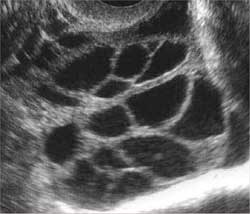
Fig 1. Ultrasound scan of ovaries when the patient has OHSS (ovarian hyperstimulation syndrome). The ovaries are markedly enlarged with multiple corpora lutea
The range of services offered by an IVF program should be carefully considered. Not all programs are equipped to provide all services, such as tubal transfer, ZIFT ( ZIFT Video ) , sperm donors , ICSI and cryopreservation of embryos. It is best to select a full-service clinic, which offers all the possible treatment options, so that the one which is best for you can be used.
The above considerations and answers to the following questions, which may be asked of the program, will help you make an informed decision when choosing an IVF/GIFT program.
What questions should you ask when selecting an IVF clinic ?
Cost and Convenience
- How much does the entire procedure cost, including drugs per treatment cycle?
- Do we pay in advance? How much?
- What are the modes of payment?
- How much do we pay if my treatment cycle is cancelled before egg recovery? Before embryo replacement?
- What are the costs for embryo freezing, storage, and transfer?
- How will the treatment schedule affect our commitments at work?
- If I must have lodging, is there a low cost place for me to stay? Do you help arrange this?
- If I do not get pregnant, when do I make my next appointment for further evaluatuation and counseling ?
Details About the Program
- How many doctors will be involved in my treatment?
- To what degree can my own doctor participate in my treatment?
- What types of counselling and support services are available?
- Whom do I call day or night if I have a problem?
- Do you freeze embryos (cryopreservation)?
- Is donor sperm available in your program? Donor eggs?
- Do you have an age limit?
Success of the Program
- When did this program perform its first IVF procedure? First GIFT procedure?
- How many babies have been born from this program's IVF efforts? GIFT efforts?
- In the past two years, how many treatment cycle have been initiated for IVF? For GIFT?
- How many deliveries were twins or other multiple births?
If you are going through an IVF cycle, you will find the following tracking chart very useful in monitoring your treatment.